If you’re buying or upgrading a CNC wood router, the spindle, control system, and gantry usually get all the attention. The worktable — the surface that actually holds your material still while a spinning bit cuts through it — gets discussed almost as an afterthought. That’s a mistake. The way you hold material down has a direct, measurable effect on your cycle times, your scrap rate, your labor cost per sheet, and ultimately how fast the machine pays for itself.
For CNC woodworking specifically, the decision usually comes down to two systems: vacuum tables and T-slot clamping tables. Some machines offer a hybrid of both. Each one holds material using a completely different mechanism, and each one is genuinely better suited to certain jobs than the other. There is no universally “correct” answer — only the right fit for your material mix, part sizes, and production volume.
This guide breaks down how each system works, where each one wins and loses, and how to think about the return on investment (ROI) of choosing one over the other — or combining both on the same machine.
How a Vacuum Table Works
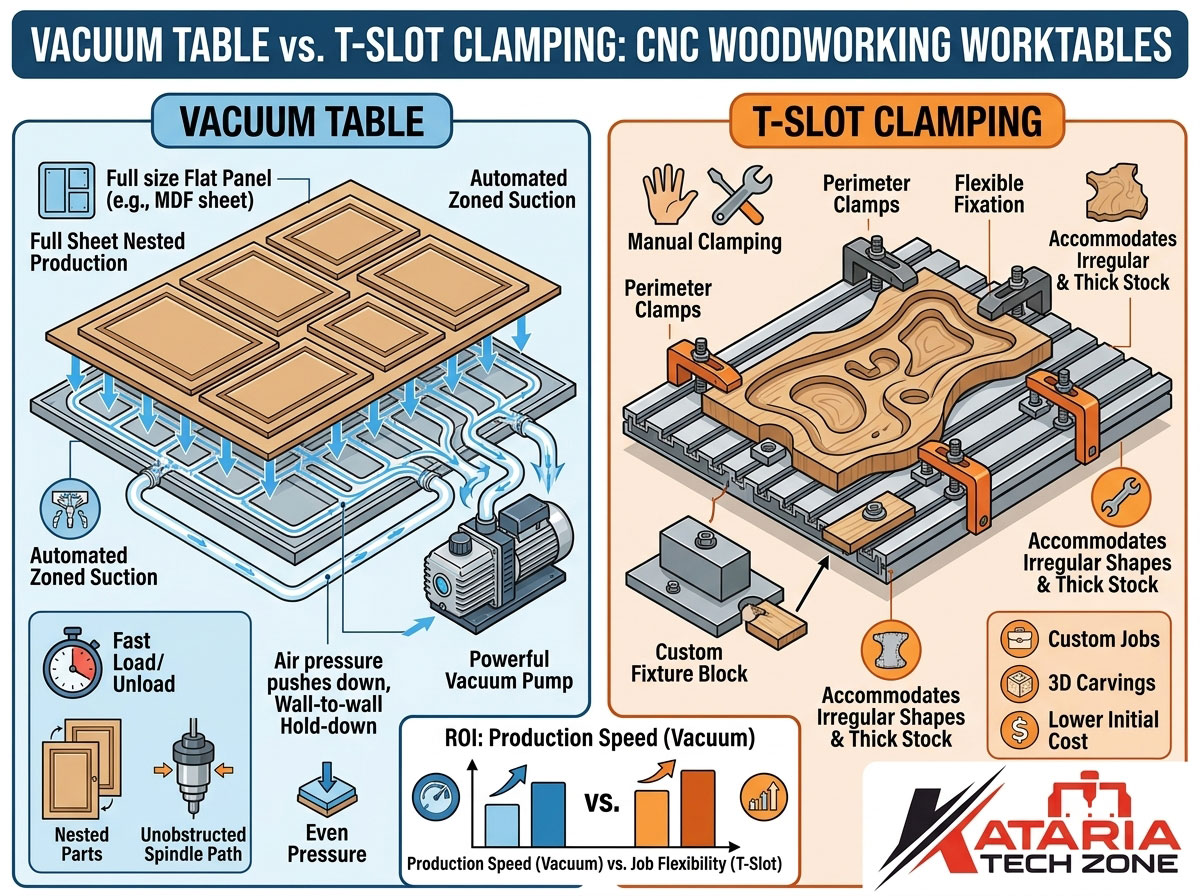
A vacuum table sits on top of (or is built into) the CNC bed. Underneath the table surface is a network of channels connected to a vacuum pump. When you switch the pump on, it pulls air out from beneath the sheet resting on the table, and atmospheric pressure above pushes the sheet down against the surface. The result is a flat, wall-to-wall hold-down force distributed across the entire underside of the material, with no clamps, screws, or fixtures anywhere near the cutting path.
Most industrial vacuum tables are divided into multiple independently controlled zones — typically four to eight — so the operator can activate only the zones actually covered by the sheet being cut. This keeps suction concentrated where it’s needed and prevents the pump from wasting capacity trying to seal zones that are empty or exposed.
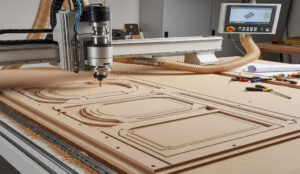
Because there’s nothing physical on the table surface to work around, the spindle can travel over the full sheet without stopping to dodge a clamp. That single fact is why vacuum tables are the default choice on high-volume, sheet-based production — cabinet doors, wardrobe panels, flat-pack furniture components, MDF and plywood parts nested across a full 4×8 (or larger) sheet.
How T-Slot Clamping Works
A T-slot table is the more traditional, mechanical approach. The table surface — usually machined aluminum — is cut with a grid of T-shaped channels running across it. To hold a workpiece, the operator slides a bolt or clamp head into a slot, positions it against the material, and tightens it down by hand or with a wrench. Multiple clamps are typically used around the perimeter (or through pre-drilled holes) of the workpiece to keep it fully secured during cutting.
Unlike a vacuum table, a T-slot table doesn’t depend on the material forming an airtight seal against the surface. It grips physically, which means it works just as well on a small offcut, an odd-shaped blank, a thick timber slab, or a part with holes and cutouts that would otherwise leak vacuum pressure. The tradeoff is setup time: every workpiece has to be manually positioned and clamped before the machine can start cutting, and the clamps themselves occupy space the spindle has to avoid.
Vacuum Table: Pros and Cons
Advantages
- Fast load and unload. Place the sheet, engage the vacuum, start cutting — the whole process typically takes seconds rather than minutes. Over a full shift, that difference adds up to a meaningful jump in throughput.
- Unobstructed toolpaths. With no clamps on the table, the spindle can nest and cut parts across the entire sheet, including right up to the edges, without programming around obstacles.
- Even, non-marking hold. Suction pressure is spread evenly across the whole panel, so there’s no risk of the crushing or denting marks that an over-tightened mechanical clamp can leave on softer or veneered material.
- Ideal for nested-based manufacturing. If your business runs repetitive cabinet, wardrobe, or flat-pack parts nested across standard sheet sizes, a vacuum table is built exactly for that workflow.
- Better accuracy on thin and lightweight panels. Thin MDF or laminate sheets that would flex or lift under a mechanical clamp stay flat and fully supported under vacuum.
Disadvantages
- Struggles with irregular or small parts. A workpiece with a small footprint, an odd shape, or lots of internal cutouts may not create enough continuous surface contact to hold a reliable seal.
- Can’t grip 3D or uneven stock. Relief carving, embossing, and material with an already-uneven underside won’t seat flat enough for the vacuum to hold securely.
- Ongoing running cost. The vacuum pump draws power continuously while it’s in use, and pump maintenance (filters, seals, oil changes on some models) is a recurring line item.
- Dependent on a working seal. Porous, badly warped, or damaged material can leak air and weaken hold-down force, sometimes without the operator noticing until a part shifts mid-cut.
- Upfront cost. A vacuum pump, zoned table, and the plumbing to connect them add meaningfully to the price of the machine compared with a bare T-slot bed.
T-Slot Table: Pros and Cons
Advantages
- Handles almost anything. Odd shapes, thick timber, small offcuts, parts with cutouts — if it can physically sit on the table, a clamp can usually hold it.
- Strong, adjustable grip. Clamping force is mechanical and directly controllable, which matters for aggressive cuts, deep relief carving, or dense hardwood that would otherwise vibrate or shift.
- No ongoing running cost. There’s no pump to power, service, or replace — the table itself is largely maintenance-free.
- Lower upfront cost. A T-slot bed is simpler to manufacture and install than a zoned vacuum system, which keeps the machine’s base price down.
- Predictable performance regardless of material condition. Warped, porous, or rough-sawn stock that would defeat a vacuum seal clamps down just as securely as a flat panel.
Disadvantages
- Slower setup per part. Positioning and tightening clamps by hand takes real time, and that time repeats for every single workpiece, every single day.
- Clamps interrupt toolpaths. The program has to route around every clamp on the table, which can mean extra passes, awkward tool changes, or areas the spindle simply can’t reach in one setup.
- Operator-dependent consistency. Two operators may tighten clamps differently, and inconsistent clamping pressure can introduce small but real variation between parts.
- Less efficient for high-volume sheet nesting. On a full 4×8 sheet cut into a dozen parts, manually clamping and re-clamping as the job progresses is far slower than a single vacuum activation.
Side-by-Side Comparison
| Factor | Vacuum Table | T-Slot Table |
|---|---|---|
| Best for | Full sheets, flat panels, nested cabinet/furniture parts | Irregular shapes, small parts, thick stock, relief carving |
| Load/unload speed | Seconds | Minutes (manual clamping) |
| Toolpath freedom | Full sheet access, no obstacles | Must route around clamps |
| Hold-down consistency | Even across the whole panel | Depends on operator tightening |
| Works on 3D/uneven stock | No | Yes |
| Running cost | Pump power + maintenance | Minimal |
| Upfront cost | Higher | Lower |
| Ideal production style | High-volume, repetitive, sheet-based | Mixed, custom, low-to-mid volume |
The ROI Question: Which One Actually Saves You Money?
The honest answer is that ROI depends entirely on what you’re producing — but the levers to think through are the same for every workshop.
1. Cycle time and labor cost per part. This is where a vacuum table earns its keep fastest. If your shop is cutting the same nested layout across full sheets all day — wardrobe panels, cabinet carcasses, shutter boards — shaving even one to two minutes of clamping time off every sheet compounds quickly across a shift. Multiply that saved time by your operator’s hourly cost and by the number of sheets you run in a month, and the payback period on the vacuum system often becomes clear within the first few months of steady production.
2. Scrap and rework. A T-slot clamp, over-tightened or positioned poorly, can dent or mark softer boards — a cost you only see when the part fails final inspection. A vacuum table removes that risk on flat panels but introduces a different one: a poor seal on a warped or porous board can let a part shift mid-cut, ruining the piece and the material underneath it. ROI here depends on which failure mode is more common with your actual material stream.
3. Machine utilization. Every minute spent hand-clamping is a minute the spindle isn’t cutting. For shops running one shift with modest order volume, that may not matter much. For shops running two or three shifts against tight delivery schedules, machine utilization is often the single biggest lever on overall profitability — and it’s the exact metric a vacuum table is designed to protect.
4. Job mix. A shop that runs 80% flat-panel cabinet work and 20% custom carved pieces will get a very different ROI picture than a shop doing the reverse. Forcing high-volume sheet work through manual clamping wastes labor; forcing small custom or 3D parts onto a vacuum table wastes machine time troubleshooting failed seals.
5. Total cost of ownership. Don’t compare only the purchase price. Factor in the vacuum pump’s ongoing power draw and service schedule against the T-slot table’s near-zero running cost, over the machine’s expected working life — typically several years of daily use.
The Hybrid Approach: Why Many Workshops Choose Both
You don’t have to choose exclusively. A growing number of CNC router beds are built as combination tables — vacuum zones with T-slots embedded between or around them. This lets an operator run standard sheet work under vacuum for most jobs, then switch to mechanical clamps for the occasional irregular part, thick blank, or relief-carved piece, all on the same machine bed. For workshops with a genuinely mixed job list — which describes most furniture and cabinetry manufacturers at some point in their growth — a combination table is often the most practical long-term choice, even though it costs more upfront than either system alone.
How to Decide for Your Shop
Ask these questions before you specify your next machine or retrofit your current one:
- What percentage of your work is flat, sheet-based, and repetitive? High percentage points toward vacuum.
- How often do you cut small, irregular, or thick 3D parts? Frequent occurrence points toward T-slot, or a hybrid bed.
- What shift pattern are you running? Multi-shift, high-throughput operations recover a vacuum system’s cost faster.
- What’s your current biggest bottleneck — machine time, or operator availability? Vacuum systems primarily save machine time; T-slot systems are cheaper on operator overhead per unit but slower per part.
- What’s your material mix? Consistently flat, dry panel stock favors vacuum. Reclaimed, rough-sawn, or variable-thickness stock favors mechanical clamping.
There’s no wrong answer here as long as the choice matches your actual production mix rather than a generic recommendation. A one-machine custom furniture workshop and a three-shift modular cabinet factory should not necessarily land on the same table configuration — even if they’re cutting similar materials.
Final Thoughts
Vacuum tables and T-slot clamping solve the same basic problem — holding material still during cutting — with fundamentally different tradeoffs. Vacuum wins on speed, consistency, and full-sheet efficiency for flat panel production. T-slot wins on flexibility, upfront cost, and its ability to handle anything you can physically set on the table, including irregular shapes and thick or 3D stock. For many growing workshops, a hybrid table that offers both isn’t a luxury — it’s the configuration that keeps a single machine useful across the widest range of jobs.
Whichever direction fits your production, the table configuration is a decision worth making deliberately rather than defaulting to whatever the base machine ships with — because over the life of the machine, it’s one of the factors that most directly affects your cost per part.
Explore CNC Wood Routers Built for Your Production Style
At Kataria Tech Zone, we manufacture CNC wood routers configured with vacuum tables, T-slot beds, and hybrid combination worktables — built around how your workshop actually runs, not a one-size-fits-all default. Talk to our team about matching the right table configuration to your material mix and production volume.
- Browse our CNC Wood Router range →
- CNC Stone Router Machines →
- Panel Saws for sheet sizing before cutting →
- Edge Banding Machines →
- Woodworking Cold Press machines →
- Vacuum Membrane Press machines →
Related reading from the Kataria Tech Zone blog:
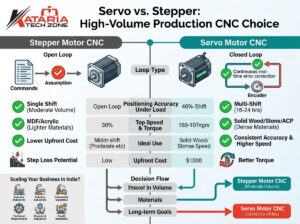
- Servo Motor vs. Stepper Motor CNC Routers: Which Is Right for High-Volume Production?
- How to Prevent Tool Breakage on CNC Routers: Bit Selection & Speed Optimization
- Why Are CNC Wood Routers Popular in Furniture and Cabinetry Making
- CNC Routers vs. Traditional Woodworking: Which Is Best?
- How to Plan the Workshop Layout for a Modern Modular Furniture Factory
- Essential Features of Modern CNC Woodworking Machines
Have questions about which table configuration suits your workshop? Contact Kataria Tech Zone — we’ll help you match the right CNC router setup to your production goals.