Metal wall art and custom signage are becoming increasingly popular across homes, offices, restaurants, hotels, retail stores, cafés, commercial buildings, and outdoor spaces. Customers are looking for personalized designs, business logos, decorative panels, nameplates, quotes, geometric patterns, and architectural metal artwork that looks premium and lasts for years.
For entrepreneurs and metal fabricators, this creates an attractive business opportunity. With the right fiber laser cutting machine, a small fabrication workshop can turn digital designs into highly detailed metal products with accuracy, repeatability, and professional finishing.
If you are planning to start a metal wall art and custom signage business in India, this guide explains the business model, equipment requirements, materials, product ideas, production workflow, pricing strategy, marketing approach, and important factors to consider before investing in a machine.
At Kataria Tech Zone, we manufacture CNC and laser cutting solutions designed for modern fabrication requirements. Our Fiber Laser Cutting Machine is designed for precision metal processing and applications such as signage, decorative panels, custom lettering, and intricate metal fabrication.
Why Start a Metal Wall Art and Custom Signage Business?
The biggest advantage of this business is the combination of customization and manufacturing.
Instead of selling a standard product, you can create products according to a customer’s exact requirements. A homeowner may want a family name or decorative tree design. A restaurant may need a customized logo sign. An interior designer may order a large geometric partition. A hotel may require decorative metal panels.
This makes custom metal products suitable for both B2C and B2B customers.
A fiber laser cutter can also help you produce complicated designs that would be difficult, slow, or inconsistent to manufacture using conventional cutting methods.
Some popular products include:
- Metal wall art
- Decorative metal panels
- Custom nameplates
- House name signs
- Garden signs
- Restaurant signs
- Café logo signs
- Office branding signs
- Metal business logos
- Directional signage
- Number plates
- Religious and cultural artwork
- Geometric wall décor
- Tree-of-life wall art
- Abstract metal artwork
- Personalized gift signs
- Architectural screens
- Room dividers
- Gate and balcony decorative panels
The key is to build a business around design, customization, quality finishing, and fast delivery, rather than simply selling cut metal.
What Is a Fiber Laser Cutter?
A fiber laser cutter uses a concentrated laser beam to cut metal sheets and plates according to a digital design. Compared with traditional mechanical cutting methods, laser cutting is a non-contact process that can produce intricate shapes and repeatable results.
Fiber laser technology is particularly suitable for metal applications because it can process materials such as mild steel, stainless steel, aluminum, brass, copper, and other compatible metals, depending on the machine configuration and laser power.
Kataria Tech Zone’s Fiber Laser Machine category focuses on solutions for precision metal fabrication, signage, decorative work, and other industrial applications.
For a wall-art business, the most important benefit is design freedom. You can create patterns with hundreds or even thousands of small details and reproduce the same design whenever a customer places another order.
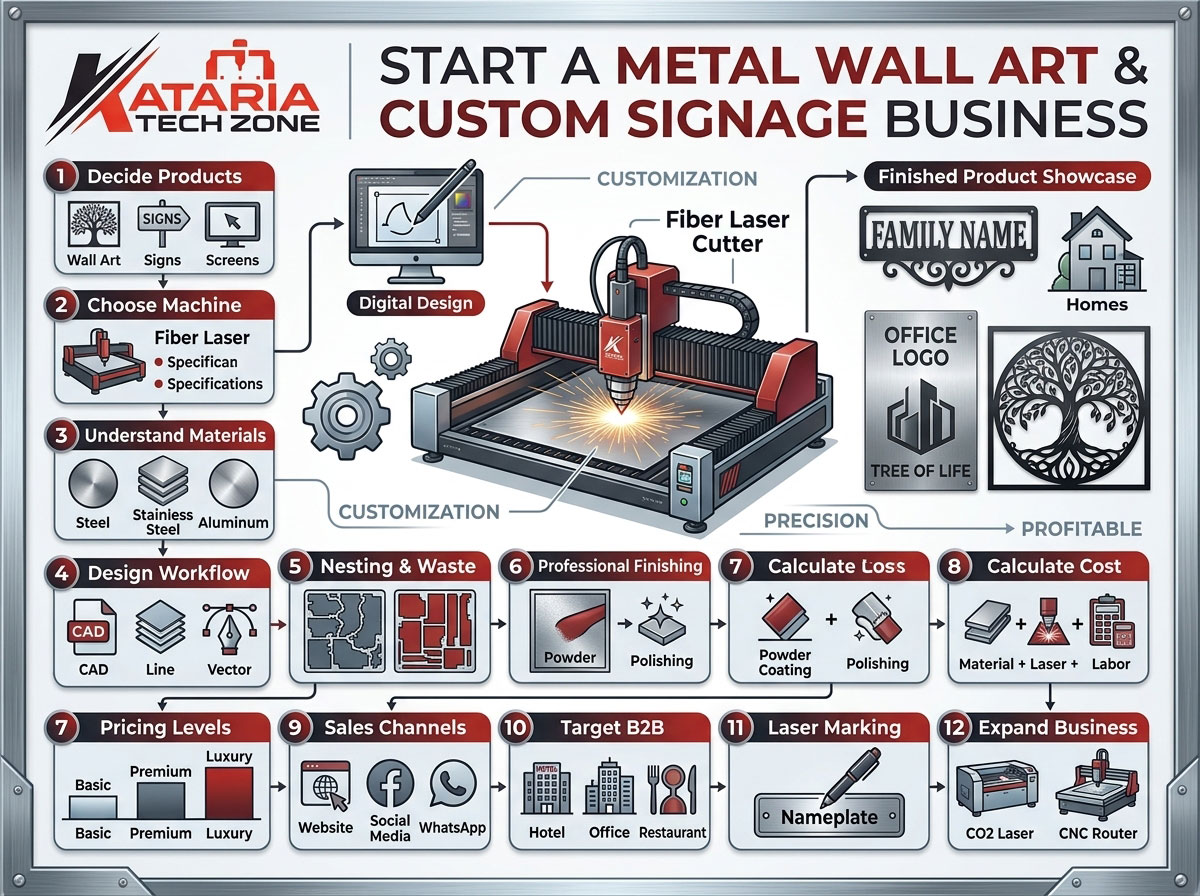
Step 1: Decide What Products You Will Sell
Before purchasing a machine, define your target market.
Do not start by trying to manufacture everything. Choose a few product categories that can be produced efficiently and marketed easily.
1. Personalized Metal Wall Art
Personalized artwork can include:
- Family names
- Initials
- Inspirational quotes
- Tree designs
- Animals
- City skylines
- Mandala patterns
- Religious designs
- Abstract artwork
Personalization allows you to charge more than generic decorative products because customers are buying something designed specifically for them.
2. Custom Business Signage
Businesses need signs for branding and identification.
You can manufacture:
- Company name signs
- Metal logos
- Reception signs
- Office signs
- Café signs
- Restaurant signs
- Retail shop signs
- Direction boards
- Parking signs
- Industrial signs
For commercial clients, emphasize professional design, accurate dimensions, consistent quality, and reliable delivery.
3. Decorative Metal Screens
Decorative screens are another strong opportunity for interior designers, architects, builders, and homeowners.
Laser-cut panels can be used for:
- Room dividers
- Balcony screens
- Garden partitions
- Exterior façades
- Staircase panels
- Ceiling décor
- Privacy screens
Large decorative panels can also create higher-value orders than small individual wall-art pieces.
Step 2: Choose the Right Fiber Laser Cutting Machine
Machine selection is one of the most important decisions in your business.
You should evaluate the machine based on:
- Laser power
- Working area
- Maximum material thickness
- Cutting speed
- Positioning accuracy
- Cutting head
- Laser source
- Control system
- Automation options
- Electrical requirements
- After-sales support
- Availability of spare parts
- Operator training
Do not select a machine only because it has the highest laser power. The right configuration depends on the materials and thicknesses you actually plan to cut.
For example, a workshop primarily producing decorative stainless-steel wall art may have different requirements from a fabrication company cutting thick mild-steel plates.
The Kataria Tech Zone Fiber Laser Cutting Machine is positioned for precision metal fabrication and applications including advertising and signage, decorative work, and sheet-metal processing.
Step 3: Understand Your Metal Materials
Your material selection will influence your product range, cutting parameters, finishing process, and selling price.
Common materials used for metal décor and signage include:
Mild Steel
Mild steel is widely used because it is versatile and can be finished in several ways.
It can be:
- Painted
- Powder coated
- Polished
- Brushed
- Patina finished
Stainless Steel
Stainless steel is popular for premium signage and contemporary décor.
It offers a modern appearance and is particularly suitable for:
- Corporate signage
- Restaurant signs
- Kitchen-related décor
- Interior wall art
- Premium nameplates
Aluminum
Aluminum is lightweight and useful when the finished product needs to be easier to install or transport.
Brass and Copper
These materials can create a premium appearance for decorative products and selected signage applications. Because material characteristics vary, cutting parameters should always be established through appropriate testing for your machine and material.
Step 4: Build a Digital Design Workflow
A successful laser-cutting business starts before the material reaches the machine.
Your workflow should generally look like this:
Customer Requirement → Design → CAD File → Material Selection → Test/Parameter Setup → Laser Cutting → Finishing → Assembly → Quality Inspection → Packaging → Delivery
Common design files may include vector formats such as DXF, AI, SVG, or other formats supported by your software and machine workflow.
Your designer should understand:
- Vector drawing
- Scaling
- Line thickness
- Kerf compensation
- Closed shapes
- Text conversion to outlines
- Nesting
- Minimum feature sizes
- Material thickness
- Mounting requirements
Design quality directly affects manufacturing quality.
A beautiful design that cannot be cut properly is not a profitable design.
Step 5: Learn Material Nesting to Reduce Waste
Material cost can significantly affect your profit.
Nesting means arranging multiple designs on a sheet to maximize material utilization.
For example, instead of cutting one wall-art design from an entire sheet, you can arrange several smaller products on the same sheet.
Effective nesting can help reduce:
- Scrap
- Material cost
- Cutting time
- Handling time
It can also allow you to sell leftover spaces as smaller products.
This is particularly useful for custom signage businesses because orders may contain different sizes and shapes.
Step 6: Add Professional Finishing
Laser cutting is only one part of creating a premium product.
The final appearance can be improved through finishing processes such as:
- Deburring
- Grinding
- Sanding
- Brushing
- Polishing
- Powder coating
- Spray painting
- Wet painting
- Clear coating
- Patina finishing
- Backlighting
- Layering
- Stand-off mounting
For example, a simple laser-cut steel design can become a premium wall-art product after powder coating and proper mounting.
Consider offering multiple finish options so customers can select according to their interior or exterior design.
Step 7: Create Multiple Pricing Levels
Avoid having only one price for your products.
Create different packages.
Basic
Laser-cut metal with a standard finish.
Premium
Laser-cut artwork with customized finishing and mounting hardware.
Luxury
Multi-layered artwork, premium finishing, special colors, customized design, lighting, and professional installation.
This approach lets you serve customers with different budgets without reducing the perceived value of your premium products.
Step 8: Calculate Your Product Cost Correctly
Many new fabrication businesses make the mistake of calculating only the metal cost.
Your actual product cost may include:
Material + Laser Cutting + Electricity + Labor + Design + Finishing + Hardware + Packaging + Transportation + Installation + Overheads
For custom jobs, also consider design revision time.
A simple way to build your quotation is:
Total Cost + Desired Profit Margin = Selling Price
However, market pricing should also be considered. A highly customized architectural metal panel should not necessarily be priced like a basic flat nameplate.
Track your production time for every product. After a few months, you will know which products generate the highest profit per machine hour.
Step 9: Sell Through Multiple Channels
Your business does not have to depend on a physical showroom.
You can generate orders through:
- Your website
- Google search
- Google Business Profile
- YouTube
- Interior designers
- Architects
- Builders
- Signage contractors
- Advertising agencies
- Furniture manufacturers
- Event companies
Create high-quality photographs and videos of your finished products.
Short videos showing the laser cutting process can be especially useful for demonstrating precision and building customer confidence.
Step 10: Target B2B Customers
B2B customers can provide recurring orders.
Instead of marketing only to individual homeowners, create a separate sales strategy for:
- Interior designers
- Architects
- Signage companies
- Advertising agencies
- Real-estate developers
- Hotels
- Restaurants
- Retail chains
- Corporate offices
- Event planners
- Fabrication contractors
For example, an interior designer may require multiple decorative panels across different projects.
A signage company may outsource specialized laser cutting rather than purchase its own machine.
This creates an opportunity for your workshop to operate as a contract laser cutting service in addition to selling finished products.
Step 11: Consider Adding Laser Marking
Once your core cutting business becomes established, you can expand into product personalization and industrial marking.
A Fiber Laser Marking Machine can be used for applications involving permanent marking, logos, serial numbers, product identification, and personalization on compatible materials.
This can open additional markets such as:
- Industrial component marking
- Metal gifts
- Nameplates
- QR-code marking
- Serial-number marking
- Tool identification
- Promotional products
- Personalized metal products
Adding marking capabilities can help diversify your revenue instead of depending exclusively on large wall-art projects.
Step 12: Use Other Machines to Expand Your Signage Business
A metal signage workshop may eventually need more than a fiber laser.
Depending on your product range, other equipment can complement your production workflow.
For non-metallic signage, acrylic, MDF, wood, and similar materials may require different technologies.
Kataria Tech Zone also offers a broader Laser Machine category covering different laser technologies and applications.
For woodworking and non-metal signage applications, you can also explore the CO2 Laser Engraving & Cutting Machine.
For routing and machining applications, the CNC Router Machine can complement a signage and fabrication workshop.
This creates an opportunity to build a multi-machine production business capable of serving customers across metal, acrylic, wood, MDF, PVC, and other suitable materials.
Step 13: Build a Strong Product Catalog
- Custom Metal Wall Art
- Laser Cut Metal Wall Art
- Metal Name Plates
- Custom Metal Signs
- Stainless Steel Signs
- Decorative Metal Panels
- Laser Cut Room Dividers
- Metal Business Logo Signs
- Garden Metal Art
- Custom House Name Plates
- Architectural Metal Screens
Each page should contain original photographs, product descriptions, material options, customization information, FAQs, and a clear enquiry button.
This gives search engines more relevant content while helping customers understand exactly what you sell.
Step 14: Create SEO Content Around Customer Questions
Useful topics include:
- How to start a metal fabrication business
- How to make laser-cut metal wall art
- Best metal for outdoor signs
- Stainless steel vs mild steel for signage
- How much does laser-cut signage cost?
- How to design laser-cut wall art
- Fiber laser cutting machine for signage
- Metal wall art business ideas
- Laser cutting business ideas in India
- How to price custom metal signs
- Decorative metal screen design ideas
- Fiber laser vs CO2 laser for metal
You can also connect this article with your existing educational content, such as Innovative Uses of CO2 Laser Machines and [The Ultimate Guide to CNC Stone Routing](https://www.katariatech)