When metal fabricators compare fiber laser machines, they talk about wattage, bed size and brand. After the machine is installed, one decision shapes your cut quality, speed and monthly running cost every single day: which assist gas you use.
The two main choices are nitrogen and oxygen. Compressed air is a third option for some jobs. Pick the wrong gas and you get rough edges, oxidized parts that won’t paint or weld cleanly, slower cutting, or a gas bill that eats your margin.
In this guide, Kataria Tech Zone explains how assist gases work, where each one wins, what each really costs, and how to choose for your shop. If you are still deciding on the machine itself, start with our comparison of fiber laser vs CO2 laser cutting for metal fabricators.
What Does an Assist Gas Actually Do?
A fiber laser melts or vaporizes metal at the focal point. The assist gas, blown through the nozzle coaxially with the beam, does several jobs:
- Blows molten metal out of the kerf so the cut stays clean and open.
- Protects the focusing lens from spatter and fumes.
- Cools the cut zone to limit the heat-affected zone (HAZ).
- Controls the chemistry of the cut edge, either by reacting with the metal (oxygen) or staying inert (nitrogen).
That last point is the heart of this comparison. The two gases work in completely different ways.
How Oxygen Cutting Works (Reactive Cutting)
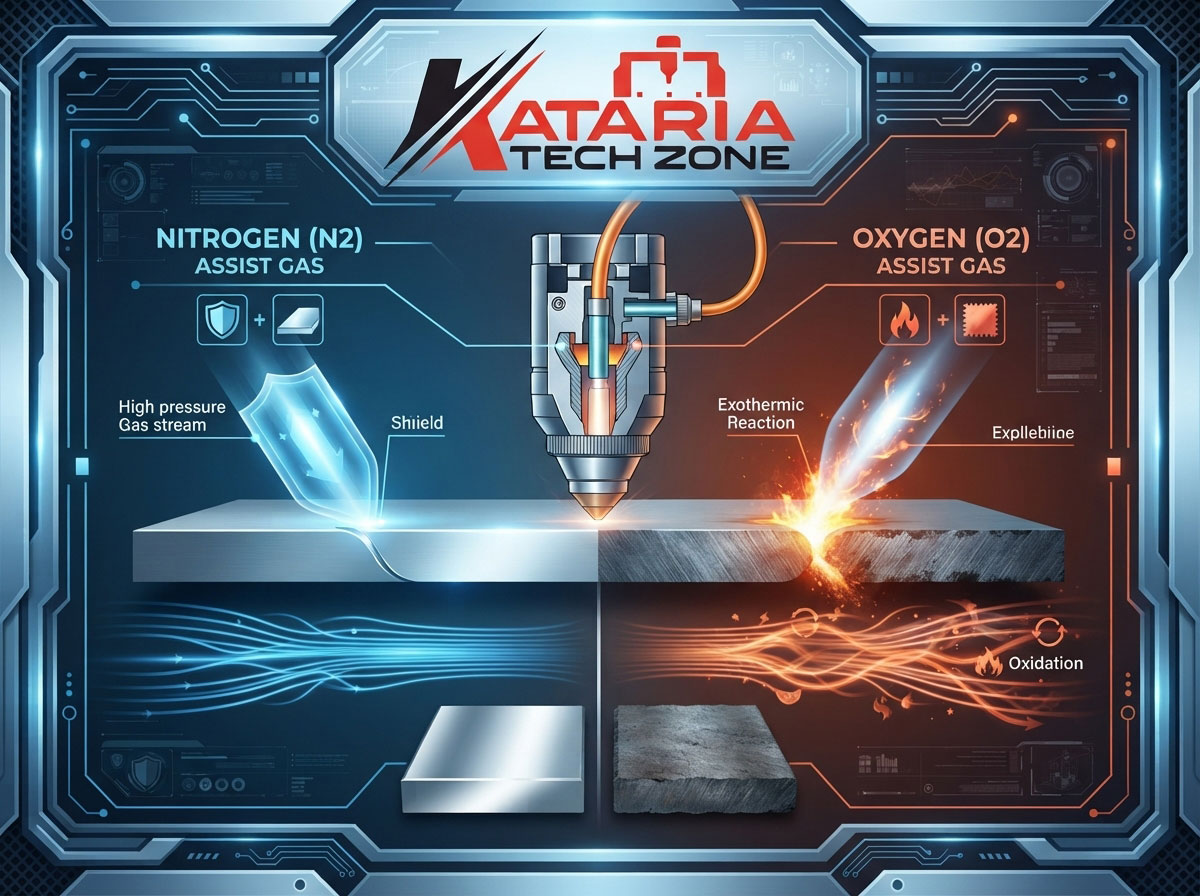
Oxygen is a reactive gas. When it hits heated mild steel, it triggers an exothermic (heat-releasing) reaction, effectively burning the steel. The laser starts the reaction, and the oxidation adds extra energy to the cut.
Result:
- Lower laser power needed for thick mild steel
- Faster cutting on thicker carbon steel plate
- Low gas pressure (typically around 0.5 to a few bar, depending on thickness and nozzle)
- An oxide layer (a dark, slightly rough film) on the cut edge
Advantages of Oxygen
- Lower gas cost. Oxygen is cheap and consumed at low pressure and flow.
- Better for thick mild steel. The exothermic reaction helps a lower-power machine cut plate that would otherwise be difficult.
- Wider process window. It is forgiving on thicker sections.
Disadvantages of Oxygen
- Oxidized edges. The dark oxide film can block paint adhesion and powder coating, and it can cause porosity in welds unless removed.
- Wider kerf and rougher finish on thin material compared with nitrogen.
- Larger heat-affected zone.
- Only suitable for carbon/mild steel. It is not a good choice for stainless steel or aluminum, where oxidation ruins the edge.
How Nitrogen Cutting Works (Inert / Fusion Cutting)
Nitrogen is inert. It does not react with the metal. Instead, the laser fully melts the material and high-pressure nitrogen physically blasts the molten metal out of the kerf. The nitrogen also shields the edge from oxygen in the air.
Result:
- A bright, clean, oxide-free edge
- Typically high gas pressure (commonly in the range of 10 to 25 bar or more, depending on material and thickness)
- High gas consumption
- Very high edge quality, ready to weld or coat in many cases
Advantages of Nitrogen
- Clean, silver edge. No oxide layer, so parts can often go straight to welding, powder coating or painting.
- Excellent for stainless steel and aluminum, where edge appearance and corrosion resistance matter.
- Fast cutting on thin sheet with a high-power fiber laser.
- Narrower kerf and smaller HAZ, with better detail on small features and holes.
- Less post-processing, which saves labor.
Disadvantages of Nitrogen
- High consumption. Nitrogen cutting uses much more gas per hour than oxygen cutting.
- Higher purity requirement. Nitrogen at about 99.95% purity or better is commonly recommended for best results.
- Needs more laser power on thicker sections, since there is no exothermic help.
- Higher running cost unless you invest in a good supply setup.
Nitrogen vs. Oxygen: Side-by-Side Comparison
| Factor | Oxygen | Nitrogen |
|---|---|---|
| Cutting mechanism | Reactive (exothermic) | Inert (melt and blow) |
| Best materials | Mild/carbon steel | Stainless steel, aluminum, brass, galvanized (as needed) |
| Edge appearance | Dark oxide layer | Bright, clean |
| Gas pressure | Low | High |
| Gas consumption | Low | High |
| Gas cost per hour | Low | Higher |
| Thick mild steel | Very good | Needs high laser power |
| Thin sheet speed | Moderate | Very fast on high-power fiber |
| Weld/paint ready | Often needs edge cleaning | Often ready to use |
| Post-processing | More | Less |
Choosing the Right Gas by Material
Mild / Carbon Steel
- Oxygen is the traditional choice, especially for thick plate where the exothermic reaction helps. It is the lowest-cost option.
- Nitrogen is chosen when the part will be powder coated or painted and you want to skip edge cleaning, mostly on thin to medium sheet.
Stainless Steel
- Nitrogen is the standard. It keeps the edge bright and preserves corrosion resistance. Oxygen would leave a dark, oxidized edge that is usually unacceptable for visible or food-grade parts.
Aluminum
- Nitrogen is the standard choice. Oxygen is generally avoided because it creates a rough, oxidized edge and poor quality.
Brass and Copper
- Reflective metals are well suited to fiber lasers. Nitrogen (or sometimes oxygen for specific cases) is used depending on thickness and edge requirements. Test cuts on your own material are important here.
Galvanized Steel
- Nitrogen or air is often used to protect the coating and keep the edge clean, though parameters depend on coating and application.
The Real Cost of Assist Gas: Beyond the Price Per Cylinder
Many shops compare gases by price per cubic meter or per cylinder. That is only part of the picture. To compare fairly, look at total cost per part.
Factors that decide your true gas cost
- Consumption rate. Nitrogen cutting at high pressure through a larger nozzle can use many cubic meters per hour. Oxygen use is far lower.
- Cutting speed. If nitrogen lets you cut thin sheet much faster, the gas cost per part may be lower than the hourly rate suggests.
- Post-processing labor. Oxide-free edges can save grinding, sanding or chemical cleaning time. This is often the hidden saving of nitrogen.
- Scrap and rework. Better edge quality means fewer rejected parts.
- Supply method. Cylinders, bundles, liquid tanks and on-site generators all have different cost structures.
A simple way to calculate cost per part
Cost per part = (Gas cost per hour + machine running cost per hour + labor per hour) ÷ parts per hour + post-processing cost per part
Illustrative example (numbers are for demonstration only): If nitrogen adds extra gas cost per hour but lets you cut 40% more parts per hour and removes a grinding step, the cost per finished part can fall even though the gas bill is higher. Always run this math with your own local gas prices and your own parts.
Nitrogen Supply Options and When Each Makes Sense
If you choose nitrogen, how you supply it matters as much as the gas itself.
1. Cylinders or Cylinder Bundles
- Low setup cost, easy to start
- Frequent changeovers and handling
- Best for low-volume or occasional nitrogen cutting
2. Liquid Nitrogen Bulk Tank
- Lower cost per unit at higher volumes
- Needs space, a vaporizer, and a supply contract
- Good for shops cutting stainless or aluminum every day
3. On-Site Nitrogen Generator
- Produces nitrogen from compressed air
- Higher upfront investment, but predictable and often lower long-term cost
- Needs a suitable compressor, dryer and filtration, and purity must meet your cutting needs
- Worth evaluating if your nitrogen use is heavy and constant
The right option depends on your hours of nitrogen cutting per month, your local gas supplier pricing, and your available space. Ask suppliers for a quote based on your actual consumption, not a generic estimate.
What About Compressed Air?
Compressed air (about 78% nitrogen, about 21% oxygen) is a low-cost third option. A clean, dry, oil-free air supply can cut thin mild steel, aluminum and some other materials at much lower cost.
Pros: very low running cost, no gas deliveries
Cons: some edge oxidation, lower quality than pure nitrogen, and it needs a properly filtered and dried compressor system, because moisture and oil can damage optics
Air is popular for thin sheet jobs where edge appearance is not critical. It is worth testing for non-visible parts.
Nozzle, Pressure and Purity: Settings That Affect Quality
Choosing the gas is only the first step. These settings decide whether your results are consistently good:
- Nozzle type and diameter. Nitrogen cutting often uses larger or double nozzles to allow high gas flow, while oxygen cutting commonly uses different nozzle geometry. Match the nozzle to the gas and thickness.
- Gas pressure. Too low and dross sticks to the bottom edge. Too high wastes gas and can cause turbulence.
- Purity. Impure nitrogen causes edge discoloration. If your cut edges look yellowish or dull, check gas purity.
- Focus position and cutting speed. Always follow your machine manufacturer’s cutting charts, then fine-tune with test cuts.
- Optics and nozzle condition. A worn nozzle or dirty protective lens ruins cut quality, whichever gas you use. For care tips, see our guide on fiber laser maintenance for optics, nozzles and chillers on the Kataria Tech Zone blog.
Common Cut Quality Problems and Gas-Related Fixes
Dross on the bottom edge:
- Check gas pressure and nozzle alignment
- Verify focus position and cutting speed
- Confirm nozzle is clean and undamaged
Yellow or discolored edge on stainless steel:
- Check nitrogen purity and for air leaks in the gas line
- Make sure the pressure is sufficient
Rough or striated edge on thick mild steel with oxygen:
- Reduce oxygen pressure and recheck focus
- Check for nozzle wear or contamination
Burn-back or over-burning on oxygen cuts:
- Slow down or adjust power and pressure for the corner or small feature
- Use pulsed or reduced power settings for small holes
Inconsistent cuts across the sheet:
- Check for gas pressure drops, regulator problems or undersized piping
- Inspect the gas hose and connectors for leaks
Decision Guide: Which Gas Should Your Shop Choose?
Choose oxygen if:
- You mainly cut thick mild steel plate
- Edge oxidation is acceptable, or parts get ground or blasted anyway
- You want the lowest gas cost
Choose nitrogen if:
- You cut stainless steel or aluminum regularly
- Parts need to be weld-ready, paint-ready or visually clean
- You want to cut thin sheet at high speed with a high-power fiber laser
- You can justify an efficient supply setup (bulk tank or generator)
Consider air if:
- You cut thin material where appearance is not critical
- Running cost is a top priority and you have a clean, dry compressed air system
Use a mix of gases if:
- Your shop cuts both thick mild steel and stainless or aluminum. Many fabrication shops run oxygen for thick carbon steel and nitrogen for stainless and aluminum on the same machine.
Does Laser Power Change the Answer?
Yes. Higher-power fiber lasers can cut thicker material with nitrogen than lower-power machines can, which narrows the old advantage oxygen had on thick plate. A lower-wattage machine may rely on oxygen for thick mild steel, while a higher-wattage machine can use nitrogen for a cleaner edge at the same thickness, at the price of higher gas use. When you size a machine, think about both your material thickness and your assist-gas strategy.
Quick Buying and Setup Checklist
Before you finalize your laser setup, make sure you have answered these questions:
- What materials and thicknesses do we cut most often?
- Do parts need to be painted, powder coated or welded after cutting?
- How many hours per month will we cut with nitrogen?
- What are local prices for cylinders, liquid nitrogen or generator options?
- Is our compressor and air treatment good enough if we plan to use air?
- Does our gas piping handle the required flow and pressure?
- Who will train operators to adjust nozzles, pressure and focus?
Explore More from Kataria Tech Zone
Metal cutting is only one part of a modern fabrication and manufacturing workshop. If you are expanding your capabilities, you may also find these helpful:
- Machines: Browse our CNC router machines, our CNC stone router machines, and the full shop.
- Related guide: Fiber Laser vs CO2 Laser Cutting: Which Machine Should Metal Fabricators Buy?
- Related guide: Automatic Edge Banding Machine Setup: How to Eliminate Glue Line Gaps and Rough Cuts
- More articles: Visit the Kataria Tech Zone blog for more guides on CNC machinery and workshop productivity.
Frequently Asked Questions
Is nitrogen or oxygen better for fiber laser cutting?
Neither is better in every case. Oxygen is cheaper and works well for thick mild steel. Nitrogen gives a cleaner, oxide-free edge and is the standard for stainless steel and aluminum.
Why is nitrogen laser cutting more expensive?
Nitrogen cutting uses high pressure and high flow, so it consumes much more gas per hour than oxygen. The extra cost can be offset by higher cutting speed and less post-processing.
Can I cut stainless steel with oxygen?
It is technically possible, but it leaves a dark oxidized edge that is usually unacceptable for appearance, corrosion resistance or hygiene-critical parts. Nitrogen is the standard choice.
Can I use compressed air instead of nitrogen?
Yes, for many thin-sheet jobs where some edge oxidation is acceptable. Air must be clean, dry and oil-free to protect your optics.
What nitrogen purity do I need?
High purity (commonly 99.95% or better) is recommended for bright, clean edges, especially on stainless steel. Check your machine manufacturer’s guidance.
Is an on-site nitrogen generator worth it?
It can be, if you cut with nitrogen for many hours each month. Compare generator investment and power cost against bulk liquid or cylinder supply using your real consumption.
Can one machine use both gases?
Yes. Most fiber laser cutting machines can switch between oxygen, nitrogen and air with the right gas supply, piping and nozzles.
Conclusion
Choosing between nitrogen and oxygen assist gas is a trade-off between cut quality and running cost, and the right answer depends on your materials, thicknesses, finishing requirements and production volume.
- Oxygen is the low-cost choice for thick mild steel, with an oxidized edge.
- Nitrogen delivers clean, bright, weld-ready edges for stainless steel and aluminum, at higher gas consumption.
- Air can be a smart economical option for thin, non-critical work.
The best approach is to calculate cost per finished part, not just cost per cubic meter of gas, and to choose a supply setup that matches your real usage.
At Kataria Tech Zone, we help workshops choose machinery that fits their production goals. Explore our products and blog, or contact our team to discuss the right setup for your shop.