
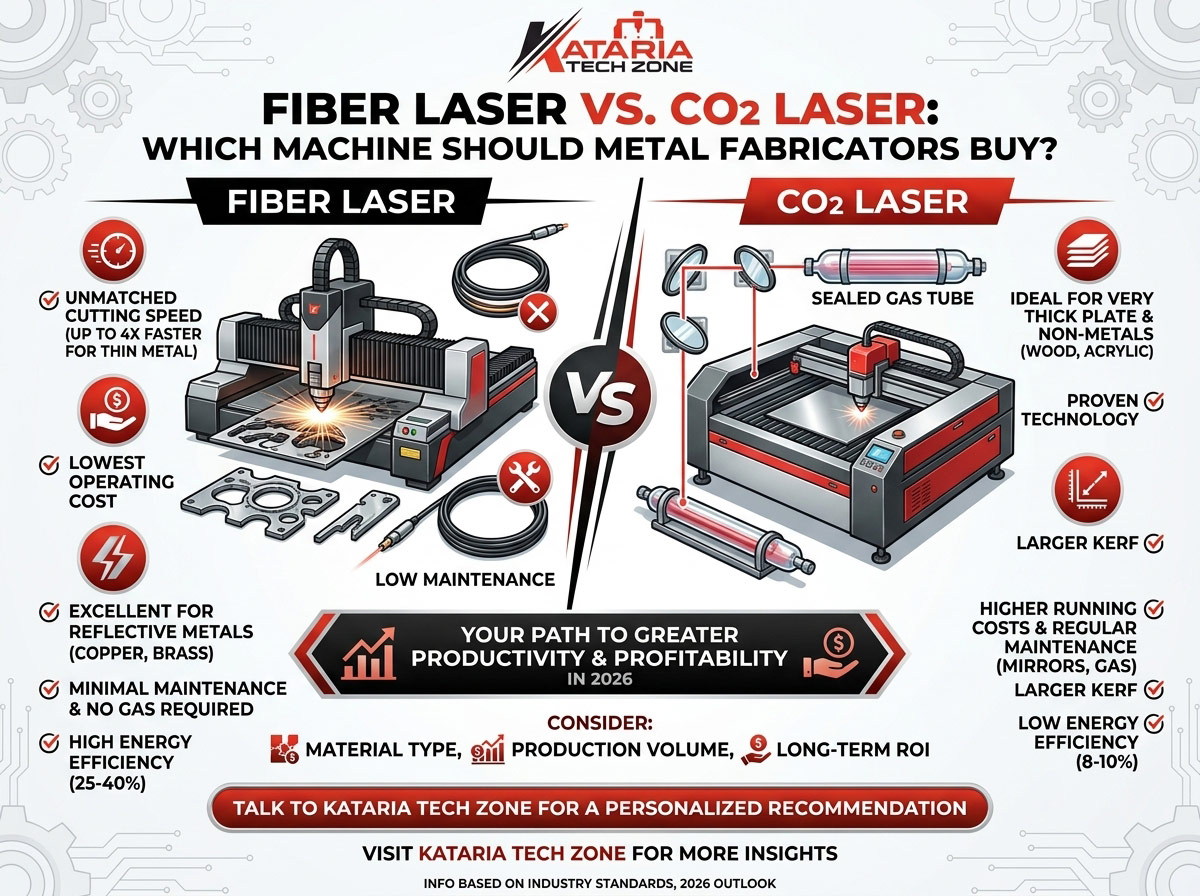
If you run a metal fabrication shop, you’ve probably asked yourself this question at least once: should I invest in a fiber laser cutting machine or stick with a CO2 laser cutter? It’s one of the biggest capital decisions a fabricator makes, and the wrong choice can mean years of higher running costs, slower turnaround, and lost bids to competitors with faster machines.
At Kataria Tech Zone, we’ve helped hundreds of metal fabrication businesses across India choose the right cutting technology for their production needs. In this guide, we’ll break down exactly how fiber laser and CO2 laser cutting machines differ, where each one excels, and how to decide which is the smarter investment for your shop in 2026.
Quick Overview: What’s the Real Difference?
Both fiber and CO2 lasers cut metal using a focused, high-intensity beam of light — but the way that beam is generated, and how it interacts with different materials, is completely different.
- CO2 lasers generate their beam by electrically stimulating a gas mixture (carbon dioxide, helium, and nitrogen) inside a sealed tube or resonator. The beam is then directed through a series of mirrors to the cutting head.
- Fiber lasers generate their beam using diode-pumped fiber optic cables doped with rare-earth elements. There are no mirrors, no gas, and far fewer moving parts.
That fundamental difference in beam generation is what drives almost every practical difference between the two technologies — speed, energy consumption, maintenance, material compatibility, and total cost of ownership.
How Fiber Laser Cutting Works
In a fiber laser system, a seed laser diode generates a low-power beam that passes through fiber optic cables doped with materials like ytterbium. As the beam travels through the doped fiber, it’s amplified repeatedly until it reaches the cutting power required — often anywhere from 1kW to 30kW or more in industrial systems.
Because the beam is delivered through a flexible fiber cable rather than bounced off mirrors, fiber laser systems have a much shorter beam path, fewer points of misalignment, and significantly less energy loss. The result is a smaller, more concentrated focal point, which translates directly into faster cutting speeds and cleaner edges, particularly on thin-to-medium gauge metals.
How CO2 Laser Cutting Works
CO2 laser systems rely on electrically exciting a sealed gas chamber to produce a laser beam with a wavelength of about 10.6 micrometers — much longer than a fiber laser’s 1.06-micrometer wavelength. This beam then bounces through a series of precision mirrors before reaching the cutting head.
Because of the longer wavelength, CO2 lasers interact differently with materials. They’ve traditionally been the go-to choice for cutting non-metals like acrylic, wood, and certain plastics, and they also perform well on thicker mild steel where a slower, more controlled cut is beneficial.
Fiber Laser vs. CO2 Laser: Side-by-Side Comparison
| Factor | Fiber Laser | CO2 Laser |
|---|---|---|
| Cutting Speed (thin-medium metal) | Up to 3-4x faster | Slower |
| Energy Efficiency | 25-40% wall-plug efficiency | 8-10% wall-plug efficiency |
| Maintenance | Minimal; no mirrors or gas to replace | Regular mirror alignment, gas refills, tube replacement |
| Best Material Thickness | Thin to medium gauge metals (up to ~25mm) | Thicker materials, non-metals |
| Reflective Metals (copper, brass, aluminum) | Excellent | Difficult; risk of beam back-reflection damage |
| Non-Metal Cutting (acrylic, wood, fabric) | Not suitable | Excellent |
| Operating Cost per Hour | Lower | Higher |
| Upfront Machine Cost | Higher initially, now closing the gap | Historically lower |
| Footprint & Setup | Compact, simpler installation | Larger footprint, more complex setup |
| Beam Quality/Focus | Tighter focus, better edge finish on metal | Slightly wider kerf on metal |
| Lifespan of Core Components | 25,000-100,000+ hours (laser source) | 2,000-10,000 hours (tube life) |
Cutting Speed and Productivity
This is often the deciding factor for high-volume metal fabricators. Fiber lasers cut thin and medium-gauge sheet metal dramatically faster than CO2 systems because the beam is more tightly focused and more efficiently absorbed by metal surfaces. On mild steel under 6mm, and especially on stainless steel and aluminum, fiber lasers can outperform CO2 machines by a wide margin.
For shops running multiple shifts or high-mix, high-volume production, that speed advantage compounds quickly — more parts per shift, faster job turnaround, and the ability to take on more orders without adding machines or labor hours.
CO2 lasers can still hold their own on thicker plate (above 12-20mm), where the longer wavelength and different heat interaction sometimes produce a smoother edge, particularly on mild steel.
Material Compatibility
This is where the two technologies really diverge.
Fiber lasers excel at cutting metals, including:
- Mild steel
- Stainless steel
- Aluminum
- Brass
- Copper
- Galvanized steel
- Titanium
Reflective metals like copper, brass, and aluminum are notoriously difficult for CO2 lasers to cut cleanly because these materials reflect a portion of the CO2 beam back toward the source, which can damage optics over time. Fiber lasers handle reflective metals with far less risk because of their shorter wavelength and beam delivery method.
CO2 lasers remain the better choice for non-metal materials, such as:
- Acrylic and plastics
- Wood and MDF
- Fabric and leather
- Rubber and foam
- Paper and cardboard
If your shop works exclusively with metal — sheet metal fabrication, structural steel, enclosures, brackets, HVAC components — a fiber laser is almost always the better long-term investment. If you regularly cut a mix of metal and non-metal materials (signage shops, furniture makers, composite fabricators), a CO2 system, or a combination of both, may still make sense.
Operating Costs and Maintenance
This is where fiber lasers pull far ahead for most metal fabrication businesses.
Fiber laser operating advantages:
- No laser gas consumables required
- No mirror alignment or cleaning
- Diode-pumped source with a rated life of 25,000+ hours, often with minimal degradation
- Lower electricity consumption per cut (wall-plug efficiency of 25-40% vs. 8-10% for CO2)
- Fewer moving optical parts means fewer breakdowns and less unplanned downtime
CO2 laser ongoing costs:
- Regular replacement of laser gas mixtures
- Periodic mirror cleaning, alignment, and replacement
- Laser tube replacement every few thousand hours, which can be a significant expense
- Higher electricity draw for the same cutting output
Over a 5-7 year ownership period, these differences add up to a substantially lower total cost of ownership for fiber laser systems in metal-focused operations, even when the CO2 machine has a lower sticker price.
Upfront Investment
Historically, CO2 lasers were the more affordable entry point, while fiber laser technology carried a premium. That gap has narrowed significantly over the past several years as fiber laser components have become more widely manufactured and more competitively priced.
Today, for a metal fabrication shop evaluating a new machine purchase, the higher upfront cost of a fiber laser is often recovered within 12-24 months through lower operating costs, less downtime, and higher throughput — a calculation worth running with your own production numbers before deciding.
Which One Should You Buy? A Practical Framework
Ask yourself these questions:
1. What materials do you cut most often? If it’s 90%+ metal, fiber is the clear winner. If you have a significant mix of non-metal work, weigh a CO2 system or a dual setup.
2. What thickness range dominates your work orders? Thin-to-medium gauge metal favors fiber. Very thick plate work sometimes favors CO2, though modern high-power fiber systems are closing this gap fast.
3. How important is uptime and low maintenance to your operation? If your shop runs tight production schedules, fiber’s minimal maintenance requirement is a major operational advantage.
4. What’s your production volume? High-volume shops benefit enormously from fiber’s speed advantage — the productivity gains compound daily.
5. What’s your budget horizon — lowest upfront cost or lowest total cost of ownership? If you’re optimizing for the next 5+ years of operation, fiber typically wins on total cost even with a higher initial price tag.
Our Recommendation for Metal Fabricators
For the vast majority of metal fabrication businesses — sheet metal shops, structural fabricators, automotive component manufacturers, and general job shops — a fiber laser cutting machine is the stronger long-term investment. It cuts metal faster, handles reflective materials that CO2 struggles with, costs less to run, and requires far less maintenance downtime.
CO2 laser cutting still has a place in shops with heavy non-metal cutting needs, but as a pure metal-cutting solution, fiber laser technology has become the industry standard for a reason.
At Kataria Tech Zone, we manufacture and supply a full range of fiber laser cutting machines built for Indian fabrication shops, from entry-level systems to high-power industrial machines designed for heavy production environments. Our team can walk you through machine specifications, power options, and ROI calculations based on your actual material mix and production volume.
Explore Our Laser Cutting Machines
Ready to see which machine fits your shop? Browse our range of cutting solutions:
- Fiber Laser Cutting Machines
- CO2 Laser Cutting Machines
- All Laser Cutting Machines
- CNC Laser Machines
Related Reads from Our Blog
- How to Choose the Right Laser Cutting Machine for Your Business
- Fiber Laser Cutting Machine Price Guide: What Affects the Cost?
- Top Maintenance Tips to Extend the Life of Your Laser Cutting Machine
- Sheet Metal Cutting: A Complete Guide for Fabricators
(Please swap in the exact live URLs for these category and blog links once confirmed — I’ve structured them to match your site’s URL pattern based on your blog link.)
Frequently Asked Questions
Is fiber laser better than CO2 for cutting steel? For mild steel up to roughly 20-25mm, fiber lasers are generally faster and more cost-efficient. CO2 can still perform well on very thick plate, but fiber systems continue to close that gap as power output increases.
Can a fiber laser cut aluminum and copper? Yes. Fiber lasers are well-suited to reflective metals like aluminum, copper, and brass, which is one of their biggest advantages over CO2 systems.
Which machine has a lower long-term cost — fiber or CO2? Fiber laser systems typically have a lower total cost of ownership due to reduced energy consumption, no gas consumables, and minimal mirror maintenance.
Do fiber lasers require special training to operate? Fiber laser machines are generally easier to operate day-to-day since there’s less manual calibration involved, though proper operator training is still recommended for safety and cut-quality optimization.
What is the average lifespan of a fiber laser source? Most industrial fiber laser sources are rated for 25,000 to 100,000+ hours of operation, significantly longer than a typical CO2 laser tube.
Talk to Kataria Tech Zone
Choosing between fiber and CO2 laser cutting technology comes down to your material mix, production volume, and long-term cost goals. Our team at Kataria Tech Zone is ready to help you evaluate your options, compare machine specifications, and find the right fit for your fabrication business.
Contact us today to get a personalized recommendation and quote for your shop.


2 thoughts on “Fiber Laser vs. CO2 Laser Cutting: Which Machine Should Metal Fabricators Buy?”