Introduction
Most industrial CNC machines are designed with three-phase motors in mind — smoother torque, higher efficiency, and stable performance under continuous load. The problem is that a large share of small workshops, home-based fabrication units, and startup manufacturing setups simply don’t have three-phase power available. Getting a three-phase connection installed can mean a lengthy application process with the local electricity board, a significant deposit, and monthly demand charges that don’t make sense for a workshop running one or two machines.
This leaves small workshop owners with a real question: can you run industrial-grade CNC machinery on single-phase power, and if so, how?
The answer is yes — with the right combination of machine selection, power conversion equipment, and electrical planning. This guide walks through exactly how single-phase power solutions work for CNC routers and related woodworking/metalworking machinery, what to check before you buy a machine, and how to avoid the power-related breakdowns that catch small workshops off guard.
Why This Matters for Small Workshops
A CNC router, laser cutter, or edge banding machine draws a very different load profile than household appliances. Spindle motors need consistent torque at startup, servo drives are sensitive to voltage fluctuation, and any dip or surge in supply can throw off a cutting job mid-run — wasting material and machine time. For a small workshop scaling from manual tools to CNC production, the power supply is often the most overlooked part of the setup, right up until the first breakdown happens.
Three-phase power is the industry default because it delivers constant power flow (no zero-crossing gaps the way single-phase AC has), which means smoother motor operation and less mechanical stress. But three-phase infrastructure is expensive to install in areas zoned for residential or light-commercial use, and many small workshops are built exactly in those zones. That’s the gap single-phase power solutions are built to close.
Understanding Single-Phase vs. Three-Phase Power
Before choosing a solution, it helps to understand what’s actually different between the two.
Single-phase power delivers electricity through a single alternating current waveform. It’s what most residential connections and small commercial units are wired for. It’s simpler to install, cheaper to run, and sufficient for lighter loads — but the power delivery isn’t continuous; it drops to zero twice every cycle, which causes a slight pulsing effect in motor torque.
Three-phase power uses three alternating currents offset from each other, so at any given moment at least one phase is delivering near-peak power. This produces smoother, more efficient motor operation, especially under the kind of continuous, high-torque load a CNC spindle motor or servo drive needs.
The practical takeaway: a machine built around a three-phase motor will run rougher — or not run at all — if you simply plug it into a single-phase line without conversion. That’s where phase converters and VFDs come in.
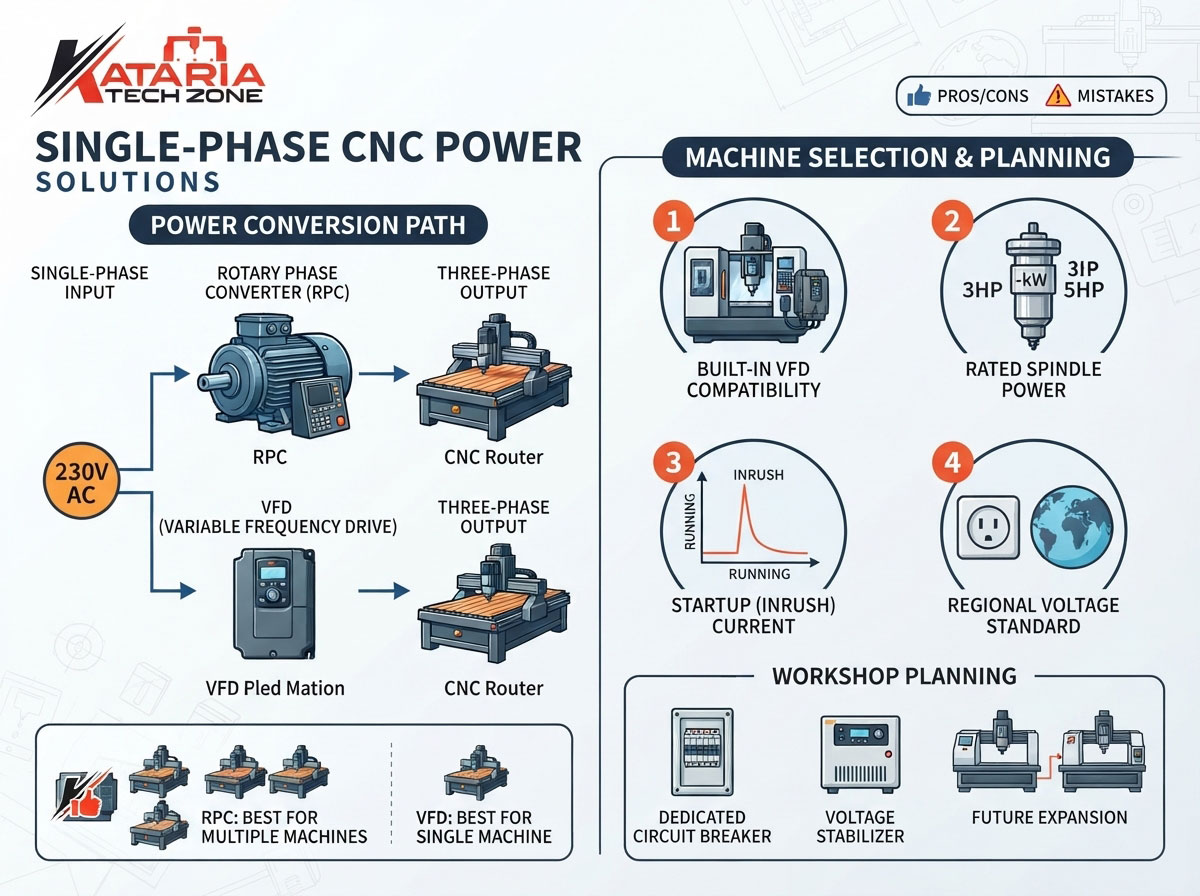
Solution 1: Rotary Phase Converters
A rotary phase converter (RPC) uses an idler motor to generate a third “phantom” phase from a single-phase supply, effectively creating a usable three-phase output.
Pros:
- Delivers relatively smooth, stable power close to true three-phase quality
- Can run multiple machines off one converter (within its rated capacity)
- Well suited for larger CNC routers, spindles, and mixed workshop equipment
Cons:
- Physically large and needs its own space and mounting
- Higher upfront cost than a VFD for a single machine
- Sizing has to account for startup current (locked-rotor amps), not just running load — undersizing is the most common mistake workshop owners make here
Rotary converters make the most sense when a workshop runs several three-phase machines off a single single-phase feed, since the cost is shared across all the equipment it powers.
Solution 2: Variable Frequency Drives (VFDs)
A VFD is the most common single-machine solution in small workshops today, and for good reason. A single-phase-input VFD takes incoming single-phase AC, converts it to DC, then inverts it back out as clean, adjustable-frequency three-phase AC — powering the spindle motor directly.
Pros:
- Compact, mounts directly at the machine
- Lets you control spindle speed precisely (a feature you need anyway for cutting different materials)
- More energy-efficient than a rotary converter for a single machine
- Often the built-in solution on CNC routers designed for smaller workshops
Cons:
- Usually rated for one machine, not a whole shop
- Input current draw is roughly double the equivalent three-phase draw, so wiring and breaker sizing still needs to account for that
- Lower-quality VFDs can introduce electrical noise that affects other sensitive equipment nearby
For a workshop running a single CNC router or a small laser/CNC combination, a VFD-equipped machine is typically the simplest and most cost-effective path — which is why it’s worth checking at the time of purchase whether the machine already ships with one built in.
Solution 3: Static Phase Converters
Static converters generate a third phase only at motor startup, then the motor continues running on roughly two-thirds of its rated power. They’re the cheapest option but are generally not recommended for CNC applications, since consistent full power delivery is exactly what precision cutting needs. They’re better suited to non-precision equipment like basic pumps or compressors — not spindle motors or servo-driven axes.
Choosing the Right CNC Machine for Single-Phase Workshops
The cleanest long-term solution isn’t always converting power to fit the machine — it’s choosing a machine engineered to run efficiently on the power you already have. When evaluating a CNC router, stone router, edge banding machine, or panel saw for a single-phase workshop, check:
- Built-in VFD compatibility — machines designed for smaller workshops often ship with single-phase-input VFDs pre-installed, removing the guesswork of sizing external conversion equipment.
- Rated spindle power vs. available supply capacity — a 5HP spindle has very different startup current needs than a 3HP spindle; match the machine to what your workshop’s electrical service can actually support.
- Startup (inrush) current, not just running current — this is the number that trips breakers and stalls converters, and it’s often left out of basic spec sheets.
- Manufacturer support for your regional voltage standard — single-phase voltage and frequency vary by country/state, and a mismatch here causes far more problems than people expect.
This is exactly the kind of decision point covered in our guide on choosing the right CNC router for your woodworking business — worth a read before finalizing a machine if you haven’t picked one yet.
Workshop Electrical Planning Checklist
Beyond the converter or VFD itself, a few planning steps prevent the majority of power-related downtime in small workshops:
- Get your available supply capacity confirmed (in kVA or amps) by an electrician before ordering a machine — don’t rely on the panel rating alone, since older buildings are frequently underrated for what’s actually usable.
- Size wiring and breakers for inrush current, not just steady-state draw. Machines with high-torque spindle motors can draw 2–3x their running current for a brief moment at startup.
- Install dedicated circuits for CNC equipment wherever possible, separate from lighting or general power, to avoid voltage dips affecting a running job.
- Add voltage stabilization if your area has known supply fluctuations — a cutting job that loses even a moment of stable voltage mid-run can ruin the material and, over time, stress servo drives.
- Plan for future upgrades. If you’re likely to add a second or third CNC machine within a couple of years, it’s often cheaper to size a rotary converter or plan for a three-phase upgrade now than to buy a second VFD-only solution later. This ties directly into the kind of scaling decisions covered in Top 7 Machinery Upgrades Every Woodworking Business Needs to Scale Production.
Cost Considerations
Single-phase solutions aren’t just a technical decision — they’re a cost decision that plays into your total cost of ownership. A VFD-equipped machine typically has a lower total setup cost for a single-machine workshop than installing a three-phase connection, once you account for utility deposits, demand charges, and installation fees. A rotary phase converter sits in the middle — higher upfront cost than a VFD, but it scales across multiple machines, which changes the math if you’re planning to grow.
If you’re weighing a power upgrade against buying additional machinery, our breakdown on calculating total cost of ownership (TCO) for CNC machines walks through how to compare purchase price against ongoing running costs — power setup included.
Common Mistakes Small Workshops Make
- Undersizing the converter or VFD based on running current alone, ignoring startup/inrush current.
- Skipping a dedicated circuit, then wondering why cuts get inconsistent whenever another machine or the AC unit kicks on.
- Buying a machine first, sorting out power second — this almost always costs more than confirming your workshop’s electrical capacity before ordering.
- Assuming any VFD works for any spindle — VFD sizing needs to match the motor’s rated horsepower and voltage, not just “close enough.”
- Ignoring voltage quality in areas with unstable grid supply, which shows up later as premature servo or spindle failure rather than an immediate problem.
How Kataria Tech Zone Helps Small Workshops Go CNC
At Kataria Tech Zone, a large share of the workshops we work with are exactly this profile — scaling up from manual tools to CNC production without access to a three-phase connection. Our CNC router and CNC stone router ranges are built with single-phase-compatible configurations available, so workshop owners don’t have to choose between industrial-grade cutting precision and the power infrastructure they actually have.
If you’re evaluating machinery for a single-phase workshop, browse our full CNC router machine range or our CNC stone router machine range, or explore the complete shop for related equipment. For more setup guidance, our blog covers everything from getting started with CNC routers for woodworking to comparing CNC routers vs. traditional woodworking tools.
Frequently Asked Questions
Can a CNC router run on single-phase power without any conversion equipment? Only if the machine’s spindle motor and control system are specifically designed for single-phase input. Most industrial CNC spindles are three-phase by design, so some form of conversion (VFD or rotary converter) is typically required unless the manufacturer has built single-phase compatibility directly into the machine.
Is a VFD or a rotary phase converter better for a small workshop? For a single machine, a VFD is usually more cost-effective and energy-efficient. For a workshop planning to run multiple three-phase machines off one supply, a rotary converter often works out cheaper in the long run.
Does single-phase power reduce CNC machine performance? Not if it’s sized and converted correctly. A properly matched VFD or rotary converter delivers power quality close enough to three-phase that most workshops see no meaningful difference in cut quality or spindle performance.
What size VFD do I need for my CNC spindle? As a starting point, size it to the spindle’s rated horsepower and voltage, then confirm against the motor’s startup (inrush) current — not just its running current — since that’s the figure that actually determines whether the VFD can handle startup without tripping.
Closing Thoughts
Single-phase power isn’t a limitation that rules out industrial CNC machinery for small workshops — it’s a planning variable. With the right VFD or phase converter, correctly sized wiring, and a machine chosen with your actual electrical capacity in mind, a single-phase workshop can run the same cutting precision as a three-phase shop, without the infrastructure cost. The workshops that run into trouble are almost always the ones that treated power as an afterthought rather than part of the machine-selection process.