Most woodworking shop owners don’t upgrade equipment because they want new machinery — they upgrade because the old setup is quietly costing them money every single day, just not in a way that shows up on a single invoice. A manual table saw is the clearest example of this. It works. It’s familiar. And it’s very likely bleeding your shop money through wasted material, rework, and labor hours you’ve stopped noticing.
The question isn’t “should I upgrade to a heavy-duty sliding panel saw?” It’s “how long will it take for that upgrade to pay for itself?” That’s a Return on Investment (ROI) question, and it has a real, calculable answer — not a guess.
This guide walks through exactly how to calculate that number for your shop, using the same framework we help customers at Kataria Tech Zone work through before they invest in a sliding panel saw.
Why This Calculation Matters More Than the Sticker Price
Most shop owners stall on this decision because they compare the wrong two numbers. They look at what they already spent on their table saw (sunk cost, effectively ₹0 going forward) against the sticker price of a new panel saw, and the panel saw looks expensive.
That’s the wrong comparison. The right comparison is:
Cost of continuing to operate the manual table saw vs. Cost of the panel saw, offset by what it saves you every month.
Once you calculate it that way, the picture usually changes fast — because a manual table saw doesn’t just cost what you paid for it. It costs you in five places you’re probably not tracking closely.
The 5 Hidden Costs of Sticking with a Manual Table Saw
1. Material Wastage
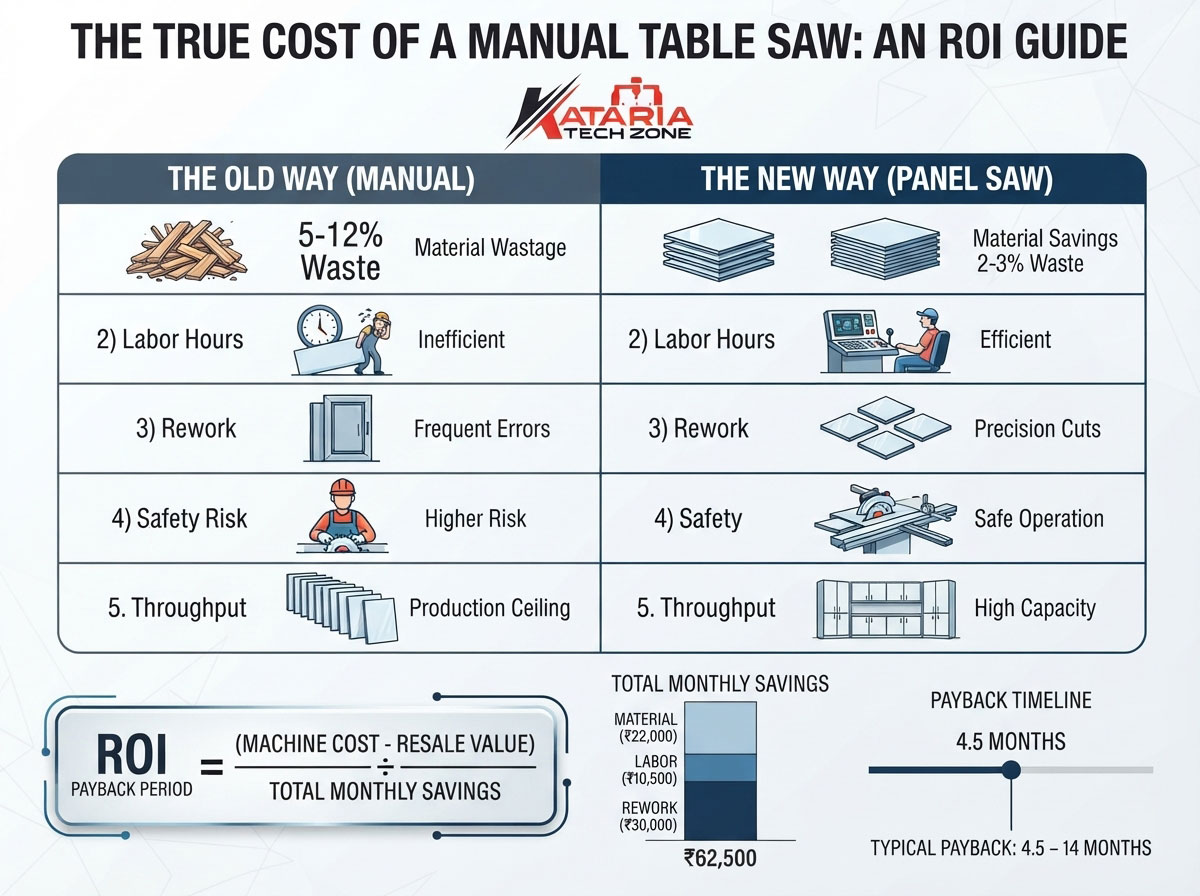
Manual crosscutting and ripping on a table saw depends entirely on how accurately a person marks, measures, and feeds the sheet. Even a skilled operator introduces small errors — a few millimeters here, a slightly off-square cut there — and on full sheets of plywood, MDF, or laminate, those errors add up to scrapped material. Industry estimates put manual-cutting material waste anywhere from 5% to 12% of sheet stock, depending on operator skill and job complexity.
2. Labor Hours
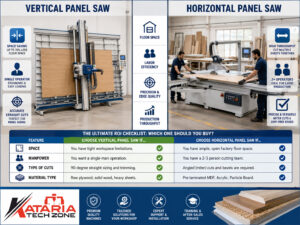
Cutting a stack of panels on a manual table saw means one operator, one sheet at a time, with re-measuring for every cut. A heavy-duty sliding panel saw with a digital fence and program memory can repeat cuts without re-measuring, and often lets one operator do the work that previously needed two.
3. Rework and Rejects
Out-of-square or inaccurate cuts don’t always get caught immediately — sometimes they surface during assembly, when a cabinet door doesn’t sit flush or an edge won’t align. Rework at that stage costs more than the original cut: you’re paying for the wasted material, the labor to identify the problem, and the labor to redo it.
4. Safety and Downtime
Manual table saws carry a higher injury risk profile than panel saws with integrated blade guards, riving knives, and pressure-beam systems, particularly when operators are pushing large, heavy sheets through the blade solo. A single safety incident — even a minor one — can mean lost workdays, compensation costs, and insurance implications that rarely make it into an equipment comparison spreadsheet.
5. Throughput Ceiling
This is the one that caps your business growth directly. A manual table saw has a hard ceiling on how many sheets one person can accurately cut in a day. If order volume grows past that ceiling, your options are hiring more labor (expensive and hard to source right now) or missing delivery timelines — both of which cost you in ways that don’t show up as a single expense line.
The ROI Formula for a Panel Saw Upgrade
Here’s the core formula:
ROI Payback Period (months) = Net Machine Cost ÷ Total Monthly Savings
Where:
- Net Machine Cost = Cost of the new sliding panel saw minus any resale value you recover from your old table saw
- Total Monthly Savings = Material savings + Labor savings + Rework savings (all calculated monthly)
Let’s break down how to actually calculate each input.
Step 1: Calculate Monthly Material Savings
Material Savings = (Current Waste % − Panel Saw Waste %) × Monthly Sheet Spend
If you’re currently spending ₹4,00,000/month on sheet material (plywood, MDF, laminate) and losing roughly 8% to manual-cutting waste, that’s ₹32,000/month in wasted material. A heavy-duty sliding panel saw with a precision fence typically brings waste down to 2–3%. That’s a reduction of roughly 5–6 percentage points, or ₹20,000–24,000/month back in your pocket just from material efficiency.
Step 2: Calculate Monthly Labor Savings
Labor Savings = (Current Labor Hours − New Labor Hours) × Hourly Labor Cost
If cutting your monthly sheet volume currently takes two operators roughly 160 hours combined, and a panel saw with a programmable fence cuts that to one operator at 90 hours, that’s a 70-hour/month reduction. At a blended labor cost of ₹150/hour, that’s ₹10,500/month in labor savings — before accounting for the fact that your freed-up skilled labor can now be redirected to higher-value finishing or assembly work instead of repetitive cutting.
Step 3: Calculate Monthly Rework Savings
Rework Savings = (Current Rework Rate % × Monthly Job Value) − (Reduced Rework Rate % × Monthly Job Value)
Even a conservative reduction from a 4% rework rate to a 1% rework rate, on a shop doing ₹10,00,000 in monthly production value, works out to ₹30,000/month in avoided rework costs.
Step 4: Add It Up and Divide
Using the example numbers above:
| Savings Category | Monthly Amount |
|---|---|
| Material savings | ₹22,000 |
| Labor savings | ₹10,500 |
| Rework savings | ₹30,000 |
| Total monthly savings | ₹62,500 |
If a heavy-duty sliding panel saw from Kataria Tech Zone costs around ₹2,80,000 net of your table saw’s resale value:
Payback Period = ₹2,80,000 ÷ ₹62,500 ≈ 4.5 months
Even for shops with more modest savings — say ₹25,000–30,000/month combined — the payback period typically lands somewhere between 9 and 14 months, which is well inside the useful life of a heavy-duty machine built to run for a decade or more.
A Simple Worksheet You Can Use Today
To run this calculation for your own shop, gather these six numbers:
- Your current monthly spend on sheet material
- Your estimated current waste percentage (be honest — most shops underestimate this)
- Current labor hours spent on cutting per month
- Your blended hourly labor cost
- Current rework/reject rate as a percentage of monthly job value
- The net cost of the new panel saw after your old table saw’s resale value
Plug those into the formulas above, and you’ll have a number specific to your shop — not an industry average.
What Changes the ROI Timeline
A few factors will speed up or slow down your payback period:
- Sheet volume: The more sheet material you process monthly, the faster material and labor savings compound. High-volume shops (cabinetry, modular furniture, retail fixtures) see the fastest payback.
- Current waste rate: Shops with less-experienced operators or more complex cutting patterns tend to have higher current waste, which means bigger savings once you switch.
- Machine specification: A heavy-duty sliding panel saw with a digital cutting-length display, pressure beam, and scoring blade will deliver more consistent waste reduction than a lighter-duty model — it’s worth spec’ing the machine to your actual production volume rather than buying the cheapest option.
- Complementary upgrades: Shops that pair a panel saw upgrade with an edge banding machine often see compounding efficiency gains, since clean, square panel edges feed directly into faster, higher-quality edge banding.
Why Shops Choose Kataria Tech Zone for This Upgrade
We’ve walked a lot of Indian woodworking businesses through exactly this decision, and a few things consistently matter to shop owners making this switch:
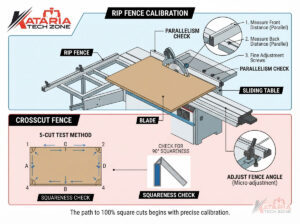
- Precision-ground sliding tables that hold square cuts consistently across full sheet runs, which is where most of your material savings come from
- Robust, industrial-grade construction built for the demands of Indian production environments, not hobbyist-grade machines rebranded for commercial use
- Local, Amritsar-based support, so servicing and spare parts don’t leave you waiting on an international supplier when a shop is mid-production
If you want to understand how panel saws stack up against manual cutting in more detail before running your own numbers, our related guides cover the mechanics further:
- What specific features of panel saws boost cutting speed and accuracy
- How does a panel saw improve efficiency compared to traditional manual cutting methods
- What Is a Panel Saw?
The Bottom Line
A manual table saw doesn’t show its true cost on any single receipt — it shows up in wasted sheets, extra labor hours, rework, and a production ceiling you eventually hit. Once you run the actual numbers for your shop, most businesses find that a heavy-duty sliding panel saw pays for itself well within a single production year, and often much sooner.
If you’d like help running this calculation against your own shop’s numbers, Kataria Tech Zone’s panel saw range is a good place to start — our team can walk through machine specifications and expected ROI based on your actual sheet volume and current setup.
Explore our full range of woodworking machinery: Kataria Tech Zone Blog