Cabinet manufacturers live and die by throughput. Every board that moves through the shop faster — without sacrificing finish quality — adds directly to daily output and bottom-line margin. One of the most overlooked levers for controlling that throughput isn’t the saw, the CNC router, or even the number of workers on the line. It’s the feed speed setting on the edge banding machine.
Feed speed sounds like a minor technical detail, but in high-volume cabinet production it’s one of the biggest single factors determining how many panels move through the shop in a shift — and whether those panels come out with a clean, durable edge or a flawed one that needs rework. In this guide, we’ll break down exactly how feed speed affects production rate, what happens when it’s set wrong in either direction, and how to match feed speed to your shop’s actual production goals.
What Is Feed Speed on an Edge Banding Machine?
Feed speed is the rate at which panels move through the edge banding machine — typically measured in meters per minute (m/min). As a panel travels through the machine, it passes through several processing stations in sequence: pre-milling, glue application, edge band pressing, trimming, and finishing (scraping, buffing, or corner rounding, depending on the machine configuration).
Every one of those stations has to complete its job correctly within the time the panel spends passing through it. Feed speed determines that window. Push the panel through faster, and each station has less time to do its job. Slow it down, and each station has more time — but the machine processes fewer panels per hour.
This is the fundamental trade-off at the heart of edge banding production planning: speed versus quality, and both translate directly into cost.
The Direct Relationship Between Feed Speed and Production Rate
The math here is straightforward on the surface. A machine running at 20 m/min will physically move more linear meters of panel edge through the system per hour than one running at 12 m/min. If your shop is processing standard cabinet-door-sized panels, that difference can mean dozens of additional finished pieces per shift.
But production rate isn’t just about how fast the machine can run — it’s about how fast it can run while still producing edges that pass quality control on the first pass. A machine cranked up to its maximum rated speed that produces edges with visible glue lines, chipping, or inconsistent trimming isn’t actually increasing your production rate. It’s shifting the bottleneck downstream to your rework and quality-control station, which often costs more time than it saved at the edge bander.
This is why experienced production managers think about feed speed not as “how fast can this machine go” but as “what is the fastest speed at which this specific panel, edge material, and glue system will still produce a first-pass-acceptable edge, every time.”
How Feed Speed Affects Each Stage of the Edge Banding Process
1. Glue Application and Bonding Quality
Hot-melt adhesive (EVA or PUR) needs a specific dwell time at the correct temperature to properly wet out and bond to both the panel substrate and the edge band material. Feed the panel through too quickly, and the glue doesn’t get adequate contact time before the pressure section — resulting in weak bond strength, edge lifting, or delamination that may not show up until the cabinet is in the customer’s home months later.
PUR adhesives, which cure through moisture reaction rather than simple cooling, are particularly sensitive to feed speed because the open time and initial bond strength both depend on consistent processing conditions.
2. Pre-Milling Accuracy
Before the edge band is even applied, most edge banders pre-mill the panel edge to remove chipping from the panel saw and create a clean bonding surface. At excessive feed speeds, pre-milling cutters can leave a rougher surface finish, which directly undermines glue adhesion in the very next station.
3. Trimming and Flush-Cutting Quality
After the edge band is pressed on, trimming units cut the excess material flush with the panel face. Trimming quality is highly speed-sensitive — cutters that perform cleanly at a moderate feed rate can start to leave “chatter marks,” uneven trim lines, or minor chipping at higher speeds, especially on delicate veneer or thin PVC edge banding.
4. Corner Rounding and Scraping (Finishing Stations)
For cabinet doors with rounded corners or radius profiles, the corner-rounding unit needs enough contact time to produce a smooth, consistent radius. Rushed feed speeds are one of the most common causes of inconsistent corner profiles across a batch — a defect that’s highly visible on a finished cabinet door and hard to correct after the fact.
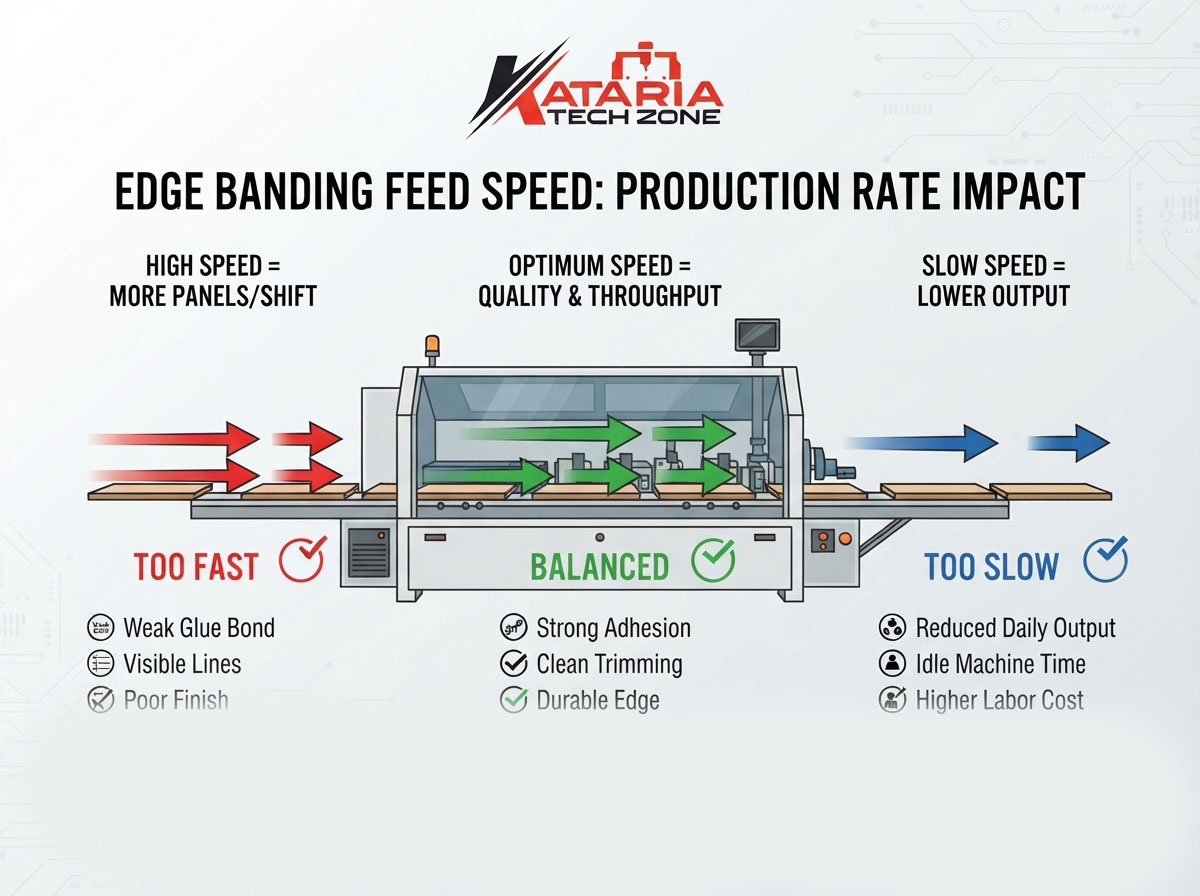
What Happens When Feed Speed Is Set Too High
- Weak glue bonds that fail inspection or, worse, fail after installation
- Visible glue lines at the panel-to-edge-band joint
- Chipping and tear-out on delicate substrates or veneers
- Inconsistent trimming, requiring hand-finishing or rework
- Increased tooling wear, since cutters are working harder per unit time at higher speeds
- Higher long-term cost, since rework and warranty issues typically cost more than the time “saved” at the machine
What Happens When Feed Speed Is Set Too Low
- Reduced daily output — fewer panels processed per shift than the shop’s order volume requires
- Increased per-unit labor cost, since fixed labor hours are spread across fewer finished panels
- Bottlenecking upstream processes (panel saws, CNC routers) that are producing faster than the edge bander can consume
- Underutilized machine capacity, meaning the shop’s capital investment in the edge bander isn’t being fully leveraged
Both extremes cost money — just in different places. The goal is finding the optimum feed speed for each specific job, not defaulting to either “as fast as possible” or “safe and slow.”
Factors That Determine the Right Feed Speed for Your Shop
1. Edge band material. PVC, ABS, veneer, and melamine edge bands all respond differently to feed speed, particularly at the trimming and corner-rounding stages. Veneer edging generally requires more conservative feed speeds than PVC to avoid tear-out.
2. Substrate type. MDF, particle board, and plywood all have different edge densities and glue absorption characteristics, which affects how much dwell time the glue station needs.
3. Adhesive type. PUR adhesives typically require different (often more controlled) feed speed windows than standard EVA hot-melt systems.
4. Panel thickness and edge band thickness. Thicker edge banding generally needs more pressure and contact time to seat properly, which can mean a lower ceiling on feed speed.
5. Machine capability. Entry-level and mid-range edge banders are rated for lower maximum feed speeds than heavy-duty, industrial-grade machines built with servo-driven feed systems and precision-controlled glue application units.
6. Order volume and batch consistency. A shop running long batches of identical panels can afford to fine-tune and hold a higher feed speed. A shop running frequent small-batch, custom orders may prioritize flexibility and consistency over maximum throughput.
How to Find Your Optimum Feed Speed
- Start with the machine manufacturer’s recommended range for your specific adhesive and edge band combination — this is your starting window, not your target.
- Run a test batch at the midpoint of that range and inspect bond strength, trim quality, and corner consistency.
- Incrementally increase feed speed in small steps, re-inspecting quality at each step.
- Identify the point where quality begins to degrade, then back off slightly from that threshold — this is your safe maximum operating speed for that specific job.
- Document the setting per job type (substrate + edge material + adhesive combination) so operators aren’t guessing on repeat orders.
Why Machine Quality Matters as Much as the Feed Speed Setting
It’s worth being direct about something here: two edge banders set to the same feed speed can produce very different results. A machine with a stable, well-engineered glue application system, precise servo-driven feed, and rigid trimming units will maintain quality at higher feed speeds than a lower-spec machine will. In other words, upgrading your edge banding machine can raise your entire feed-speed-versus-quality curve, letting you run faster without the quality trade-offs that would occur on older or lower-grade equipment.
This is a major reason cabinet shops scaling up production often find that the fastest path to higher throughput isn’t just tuning feed speed — it’s investing in an edge bander built for higher sustained feed rates in the first place.
Final Thoughts
Feed speed is one of the highest-leverage, most under-optimized variables in cabinet manufacturing. Get it right, and you unlock meaningful gains in daily output without touching labor headcount or floor space. Get it wrong in either direction, and you’re either producing defects that cost more than the time saved, or leaving capacity on the table that your shop paid for and isn’t using.
The shops that consistently hit their production targets are the ones that treat feed speed as a calibrated, job-specific setting — backed by the right machine for the job — rather than a single number left unchanged across every order that comes through the door.
Explore Our Edge Banding Machines
Looking to upgrade to an edge banding machine built for higher, more consistent feed speeds without sacrificing finish quality? Browse our range of edge banding machines engineered for reliable, production-grade cabinet manufacturing.
You may also want to explore our other woodworking machinery categories:
- CNC Router Machines
- CNC Stone Router Machines
- Full product range: Shop All Machines
Related Reading
- Manual Edge Banding vs. Automatic Edge Banding: When Should a Workshop Upgrade?
- Top 5 Causes of Edge Band Tape Peeling and How to Fix Them Instantly
- Essential Features of Modern CNC Woodworking Machines
- Visit our full Blog for more woodworking machinery guides from Kataria Tech Zone.