
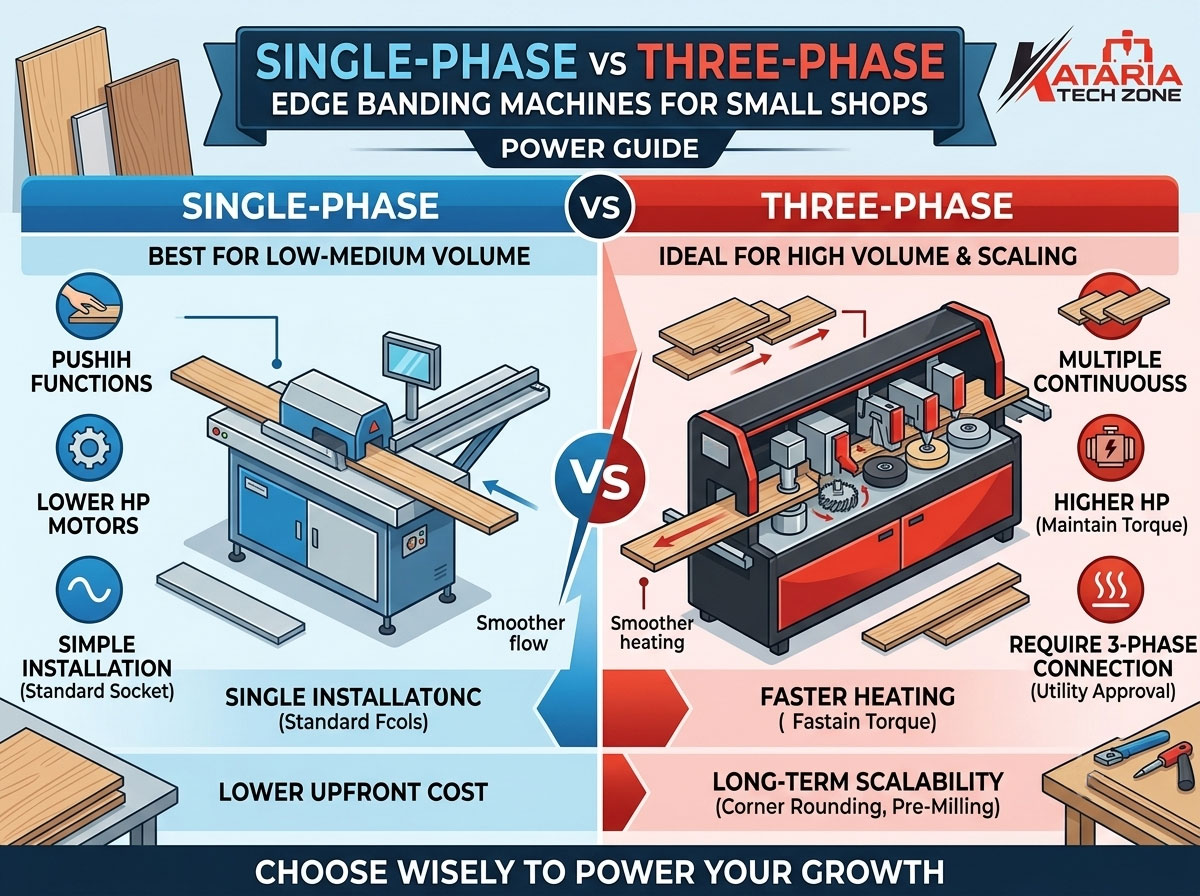
If you run a small woodworking shop, chances are you’ve already had this conversation with an electrician, a machine dealer, or a fellow workshop owner: “Should I go for a single-phase edge banding machine, or is three-phase worth the trouble?”
It’s one of the most common — and most consequential — decisions small and medium furniture makers face when they move from manual edge finishing to a proper edge banding machine. Get it right, and you get years of smooth, efficient production. Get it wrong, and you end up either underpowered for your growth plans or paying for infrastructure and electricity you don’t actually need yet.
This guide breaks down exactly what single-phase and three-phase power mean for an edge bander, how each affects your machine’s performance, what it costs to run, and how to decide which one fits your shop’s current size — and where you want to be in two or three years.
Why Power Supply Matters So Much for an Edge Banding Machine
An edge banding machine isn’t a single motor doing one job. A modern automatic edge bander runs multiple synchronized units — glue melting and application, edge feed, end trimming, top-and-bottom fine trimming, scraping, and buffing — often all working in sequence on a moving conveyor. Each of these stations draws power, and some (like the glue tank heaters and the trimming motors) need a steady, strong supply to perform consistently.
The type of electrical supply feeding your machine — single-phase or three-phase — directly affects:
- How much continuous power the machine can draw without strain
- How consistently the motors run under load
- How fast the machine heats glue and reaches operating temperature
- Whether you can add pre-milling, corner rounding, or grooving units later
- Your electricity connection cost and monthly running cost
Understanding these differences before you buy saves you from a mismatched investment.
Single-Phase Power: The Basics
Single-phase electricity is the standard supply found in most homes and small commercial units across India. It delivers power through a single alternating current waveform and is typically rated for lower continuous loads — commonly up to 5-7.5 HP for industrial motors, depending on your local connection.
Where Single-Phase Edge Banders Fit
Single-phase edge banding machines are generally the manual and semi-automatic models — machines designed for lower daily volumes, simpler edge profiles, and workshops that don’t yet run continuous eight-hour production shifts.
Typical single-phase edge bander characteristics:
- Lower horsepower motors (better suited to lighter-duty gluing and trimming units)
- Simpler electrical installation — often no special connection required from your utility provider
- Lower upfront electrical infrastructure cost
- Slightly longer glue heat-up times compared to three-phase units
- Adequate for occasional or batch-based edge banding rather than continuous runs
Advantages of Single-Phase Machines
- Lower entry cost. You avoid the cost of upgrading your electrical connection, which can be a meaningful saving for a shop just starting to mechanize.
- Simple installation. Most small workshops already have single-phase supply, so the machine can often be running the same day it arrives.
- Lower standing charges. Utility providers typically charge higher fixed and demand charges for three-phase industrial connections, even in months when you don’t run the machine much.
- Good fit for low-to-medium volume. If you’re banding a few dozen panels a day rather than a few hundred, a single-phase machine won’t leave performance on the table.
Limitations to Keep in Mind
- Motors run less efficiently under sustained heavy load compared to three-phase motors of similar rated output.
- Glue tanks and trimming motors may take longer to stabilize at full operating temperature and speed.
- Upgrading to add more processing stations later (pre-milling, corner rounding) can be constrained by available single-phase capacity.
Three-Phase Power: The Basics
Three-phase electricity delivers power through three alternating currents offset from each other, providing a smoother, more constant flow of power. This is the standard supply for factories, larger workshops, and any facility running heavier industrial machinery continuously.
Where Three-Phase Edge Banders Fit
Three-phase supply is what powers most fully automatic edge banding machines — the workhorse machines built for higher throughput and multi-station processing, like Kataria Tech Zone’s Auto Edge Banding Machine and fully automatic edge bander range.
Typical three-phase edge bander characteristics:
- Higher horsepower motors that maintain torque under continuous load
- Faster, more stable glue melting and temperature regulation
- Smoother synchronization across multiple processing stations (gluing, trimming, scraping, buffing) running simultaneously
- Better suited to continuous multi-hour production runs
- Room to add optional stations like pre-milling, corner rounding, and grooving without straining the power supply
Advantages of Three-Phase Machines
- Consistent performance under load. Three-phase motors don’t dip in performance the way single-phase motors can when multiple stations are drawing power at once.
- Higher production capacity. If your shop is processing large batches of modular kitchen or wardrobe panels daily, three-phase power supports the sustained output an automatic edge bander is built for.
- Better long-term scalability. As you add corner rounding, pre-milling, or a second edge bander, your electrical infrastructure is already equipped to handle it.
- Lower energy loss. Three-phase systems are inherently more efficient at converting electrical energy into mechanical work, which can translate into modest but real savings on your electricity bill per unit of output.
- Longer motor life. Reduced electrical strain generally means less wear on windings and bearings over years of daily use.
Limitations to Keep in Mind
- Requires a three-phase connection from your electricity provider, which may involve an application, inspection, and additional monthly demand charges.
- Higher upfront infrastructure cost if your building doesn’t already have three-phase supply.
- Slight overkill if your shop’s daily output doesn’t come close to using the machine’s full capacity.
Single-Phase vs. Three-Phase: Side-by-Side Comparison
| Factor | Single-Phase | Three-Phase |
|---|---|---|
| Typical machine type | Manual / semi-automatic edge banders | Automatic / fully automatic edge banders |
| Best suited for | Small shops, low-to-medium daily volume | Growing shops, high daily volume, continuous shifts |
| Installation | Usually no special connection needed | May require new connection & utility approval |
| Motor performance under load | Adequate, can dip under multiple simultaneous stations | Stable and consistent across all stations |
| Glue heat-up & temperature control | Slightly slower | Faster, more consistent |
| Upfront electrical cost | Lower | Higher (if upgrade needed) |
| Running cost per unit of output | Slightly higher | Slightly lower (better efficiency) |
| Scalability for extra stations | Limited | High |
| Long-term motor wear | Moderate | Lower |
How to Decide: Questions to Ask Your Own Shop
Rather than asking “which is better” in the abstract, ask these questions about your actual operation:
1. What’s your daily panel volume today — and in two years?
If you’re banding fewer than 100-150 panels a day and don’t expect that to grow sharply, a single-phase semi-automatic machine is often the more sensible investment. If you’re already processing modular furniture in volume, or expect to scale toward continuous production, three-phase automatic machines pay for themselves faster.
2. Do you already have three-phase supply at your unit?
If your workshop building already has a three-phase connection (common in dedicated industrial sheds and larger commercial units), the “extra cost” argument for three-phase machines largely disappears — you’re not paying for new infrastructure, only for the machine itself.
3. How many processing stations do you actually need?
A basic edge bander with gluing, feeding, and trimming can often run comfortably on single-phase power. But the moment you add pre-milling, corner rounding, or a grooving unit — features covered in our guide on automatic edge banding machine setup and troubleshooting — three-phase power gives you the headroom to run them without performance loss.
4. What’s your realistic budget for infrastructure, not just the machine?
Factor in not just the machine price but any electrical upgrade cost, wiring, and the difference in monthly utility charges. A three-phase machine that’s technically more efficient can still cost more overall in year one if a new connection is required.
5. Are you planning to add other three-phase machinery anyway?
If a panel saw or a heavier-duty Combi Planer is also on your roadmap, it may make sense to invest in three-phase infrastructure once and size your edge bander accordingly, rather than upgrading piecemeal.
A Practical Path for Growing Small Shops
Many small woodworking shops don’t need to choose once and for all. A common and financially sound path looks like this:
- Start with a single-phase manual or semi-automatic edge bander while volumes are moderate and you’re still refining your product line and finish quality.
- Track your daily throughput and bottlenecks. If the edge banding station becomes the slowest point in your line, or your finish quality demands features like corner rounding, that’s your signal to reassess.
- Upgrade to a three-phase automatic edge banding machine once volume, budget, and available power supply align — ideally when you’re also planning to expand your floor with other three-phase equipment, so the electrical upgrade serves multiple machines at once.
This staged approach avoids over-investing in infrastructure before your production actually needs it, while keeping a clear upgrade path in view.
Common Mistakes Small Shops Make
- Buying a three-phase machine without confirming supply availability first. Always check with your local electricity board on connection timelines and demand charge implications before finalizing your machine choice.
- Choosing single-phase purely to save money upfront, then discovering within a year that production volume already outpaces the machine — leading to a second, avoidable purchase.
- Ignoring glue and trim quality issues that are actually load-related, not machine-related. If you’re seeing inconsistent bonding or trimming under continuous use, our detailed troubleshooting guide on eliminating glue line gaps and rough cuts is a useful next read.
- Not budgeting for the total cost of ownership — machine price, power connection, and monthly running costs together, not the sticker price alone.
Final Thoughts
There’s no universally “correct” answer to single-phase vs. three-phase — the right choice depends entirely on your shop’s current volume, growth trajectory, and existing electrical infrastructure. Single-phase machines remain a smart, low-friction entry point for small shops with moderate output. Three-phase automatic machines are the better long-term investment once you’re running continuous, higher-volume production or planning to add advanced processing stations.
At Kataria Tech Zone, we work with small workshops and large-scale furniture manufacturers alike, and we help you match the right power configuration to your actual production needs — not just sell you the biggest machine available. Browse our full range of edge banding machines, including the Auto Edge Banding Machine and our fully automatic edgebander, or contact our team to discuss which configuration fits your shop.
Frequently Asked Questions
Can I run a three-phase edge banding machine on a single-phase supply using a converter? Technically, phase converters exist, but they add cost, some power loss, and potential reliability issues. For a shop planning long-term automatic machine use, arranging an actual three-phase connection is generally the more reliable route.
Does single-phase power affect edge banding quality? Not necessarily, for machines actually designed for single-phase operation. Quality issues arise when a machine’s power supply is undersized for its motor load — always match the machine’s rated power requirement to your available supply.
Is three-phase always more expensive to run? Not per unit of output. Three-phase motors are more energy-efficient under load, so while the connection and demand charges may be higher, the cost per panel processed can actually be lower at higher volumes.
What HP range typically needs three-phase supply? This varies by machine and local utility rules, but as a general guide, industrial motors above roughly 5-7.5 HP, or machines running several simultaneous high-load stations, usually require or strongly benefit from three-phase supply.
How do I know which edge bander is right for my shop’s volume? Our team at Kataria Tech Zone can review your daily production targets, panel types, and existing power infrastructure to recommend the right model — get in touch for a tailored recommendation.
Looking for more workshop planning guidance? Read our related post on how to plan the workshop layout for a modern modular furniture factory, or browse more articles in our Wood Working blog category.


One thought on “Single-Phase vs. Three-Phase Edge Banding Machines for Small Woodworking Shops”