If you run an edge banding machine long enough, you eventually hit a job where the “standard” glue doesn’t cut it — a kitchen panel that needs to survive steam and splashback, a curved profile that keeps showing hairline glue lines, or a client asking why the edge on a batch from six months ago is starting to lift. Nine times out of ten, the answer traces back to one decision made before the machine ever started running: EVA or PUR adhesive.
Both are hot-melt glues used to bond edge banding — PVC, ABS, melamine, veneer — to the raw edge of a panel. But they behave very differently once they leave the glue pot, and choosing the wrong one can cost you far more in rework and callbacks than the glue itself ever saved. This guide breaks down EVA and PUR across the three factors that actually decide the choice: water resistance, bond strength, and cost.
What Is EVA Glue?
EVA (ethylene-vinyl acetate) is the standard hot-melt adhesive used in most edge banding operations. It’s a thermoplastic — meaning it melts when heated and re-solidifies as it cools, with no chemical curing involved. That makes it simple to work with: heat it, apply it, press the banding, and the bond sets within seconds as the glue cools back down.
Why EVA remains popular:
- Lower material cost per kilogram than PUR
- No curing time — parts can be trimmed and shipped almost immediately
- Easier cleanup, since uncured EVA glue lines can be reheated and adjusted
- Works well across a wide range of standard indoor furniture and cabinetry applications
Where EVA falls short:
- Softens again when exposed to heat, which limits its use near heat sources (dishwashers, stovetops, radiators)
- Moisture resistance is moderate at best — prolonged exposure to steam or standing water can weaken the bond over time
- Glue lines are more visible, especially on thin or dark banding, since EVA doesn’t achieve as tight a bond line as PUR
What Is PUR Glue?
PUR (polyurethane reactive) adhesive is also applied hot, but it doesn’t just cool and solidify — it cures through a chemical reaction with moisture in the air. Once cured, PUR becomes thermoset, meaning it won’t re-melt when reheated. That single difference is what drives almost every advantage PUR has over EVA.
Why shops upgrade to PUR:
- Far superior water and moisture resistance — the cured bond holds up under steam, humidity, and even direct water contact, which is why PUR is now close to mandatory for kitchen and bathroom cabinetry
- Higher bond strength, particularly on curved or postformed edges where the bond needs to resist flexing stress
- Heat resistance — PUR-bonded edges don’t soften near ovens, dishwashers, or heated countertops
- Produces a near-invisible glue line (“zero-joint” or “seamless” edge banding), which is increasingly expected in premium cabinetry and furniture
The trade-offs:
- Higher material cost per kilogram than EVA
- Requires a curing period (typically 24–48 hours) before parts reach full bond strength, which affects production scheduling
- Needs careful glue pot management — PUR reacts with ambient moisture, so unused glue can begin curing inside the machine if it isn’t cleaned or managed properly, which adds a maintenance step EVA doesn’t require
- Cleanup is harder once PUR has cured, since it can no longer be softened with heat
Water Resistance: The Deciding Factor for Most Shops
This is usually where the decision gets made. EVA bonds are moisture-tolerant, not moisture-proof — fine for a bedroom wardrobe or an office cabinet that will rarely see standing water, but risky for anything near a sink, dishwasher, or high-humidity environment. Over months of exposure, moisture can work into the glue line and cause the banding to lift or peel, especially at panel corners and seams.
PUR’s chemically cured bond is a different category entirely. It’s the reason kitchen manufacturers, bathroom vanity producers, and outdoor-adjacent furniture makers have largely standardized on PUR for any panel edge that might see water. If your shop is doing kitchen cabinetry, laminate worktops, or bathroom furniture, PUR isn’t really optional anymore — most quality specifications for these categories assume it.
Bond Strength and Finish Quality
PUR consistently outperforms EVA on raw bond strength, and the gap widens on more demanding geometries. Postformed edges, tight radius curves, and thin banding on high-pressure laminate all put more stress on the glue line than a flat, straight edge does — and that’s exactly where EVA bonds are more likely to fail first.
PUR also produces a thinner, more consistent glue line, which is why it’s the adhesive of choice for the “invisible edge” look increasingly demanded in modern cabinetry and furniture design. If your customers are asking for a seamless finish where the edge banding appears to blend directly into the panel, EVA generally can’t get you there — that finish quality is a PUR-specific result.
Cost Comparison: Where the Real Number Lives
On a pure per-kilogram basis, EVA is cheaper — often by a significant margin. But comparing raw material cost alone misses the bigger picture for a production shop:
- Rework and warranty cost: A batch of EVA-bonded panels that fail in a humid environment can cost far more in replacement, labor, and reputation than the glue savings ever delivered.
- Cycle time: EVA’s near-instant set allows faster turnaround on jobs where curing time isn’t practical. PUR’s cure window needs to be built into your production schedule.
- Machine and maintenance cost: PUR application typically requires machines with heated glue systems designed for reactive adhesives, and more disciplined cleaning routines to prevent the glue pot from curing solid. This is a real operating cost difference, not just a glue price difference.
The practical rule most shops land on: use EVA for cost-sensitive, dry-environment furniture where speed matters more than water resistance. Use PUR for kitchen, bathroom, high-moisture, or premium-finish work where bond failure isn’t an acceptable risk.
Machine Compatibility: Can Your Edge Bander Run Both?
Not every edge banding machine is built to run PUR out of the box. PUR glue pots need to reach and hold higher, more consistent temperatures, and because PUR reacts with atmospheric moisture, the glue application system needs a design that limits air exposure to reduce premature curing inside the machine. If you’re currently running EVA-only equipment and considering a shift toward kitchen or bathroom cabinetry work, it’s worth checking whether your existing machine supports a PUR-compatible glue system before committing to the switch — retrofitting isn’t always straightforward, and running PUR through equipment not designed for it usually causes more maintenance headaches than it’s worth.
This is one of the most common upgrade conversations we have with workshops scaling into higher-spec cabinetry: the panel design and edge banding choice are ready for PUR, but the machine isn’t. If you’re evaluating new equipment, Kataria Tech Zone’s edge banding machines are worth reviewing for shops planning to run both adhesive types reliably.
Quick Decision Guide
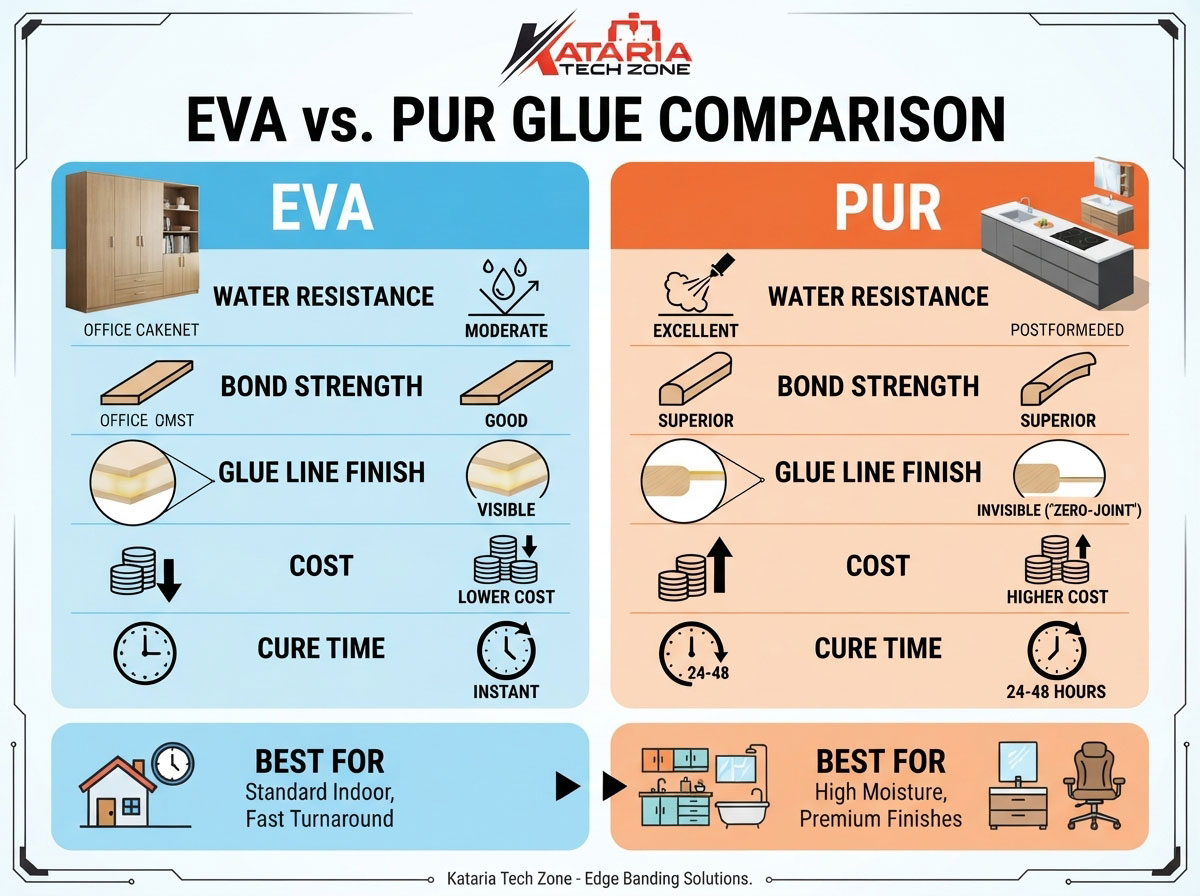
| Factor | EVA | PUR |
|---|---|---|
| Water/moisture resistance | Moderate | Excellent |
| Bond strength | Good | Superior, especially on curves |
| Heat resistance | Softens with heat | Stable under heat |
| Glue line finish | Visible | Near-invisible (“zero-joint”) |
| Material cost | Lower | Higher |
| Cure time | Instant | 24–48 hours |
| Best for | Standard indoor furniture, dry environments, fast turnaround jobs | Kitchens, bathrooms, curved/postformed edges, premium finishes |
Final Word
There’s no universally “better” glue — EVA and PUR solve different problems. EVA keeps cost and cycle time down for standard furniture work where moisture isn’t a serious concern. PUR costs more and needs a cure window, but it’s the only realistic choice once water resistance, heat exposure, or a seamless finish are part of the spec.
If you’re setting up a production line that needs to handle both adhesive types reliably — or upgrading from manual to automatic edge banding as your order mix shifts toward kitchen and bathroom work — it’s worth pairing the glue decision with the right machine from the start. Related reading on our blog covers Manual Edge Banding vs. Automatic Edge Banding: When Should a Workshop Upgrade?, Top 5 Causes of Edge Band Tape Peeling and How to Fix Them Instantly, and How Edge Banding Machine Feed Speeds Impact Production Rate in Cabinet Manufacturing. Browse our full range of edge banding machines and other CNC router machines, or explore more machining guides on the Kataria Tech Zone blog.
Kataria Tech Zone manufactures CNC routers, stone routers, edge banding machines, and woodworking equipment for fabrication businesses scaling production.