Every woodworking business hits the same wall eventually: orders are growing faster than your shop floor can keep up. Deadlines slip, material waste creeps up, and skilled labor gets stretched thin doing repetitive work a machine could handle better. At that point, the question isn’t whether to upgrade your machinery — it’s which upgrades actually move the needle.
Not every piece of equipment delivers the same return. Some upgrades shave minutes off a single process; others fundamentally change how much work your shop can take on. This guide breaks down the seven machinery upgrades that consistently make the biggest difference for woodworking businesses moving from manual or semi-manual production into serious scale — along with what to look for before you buy.
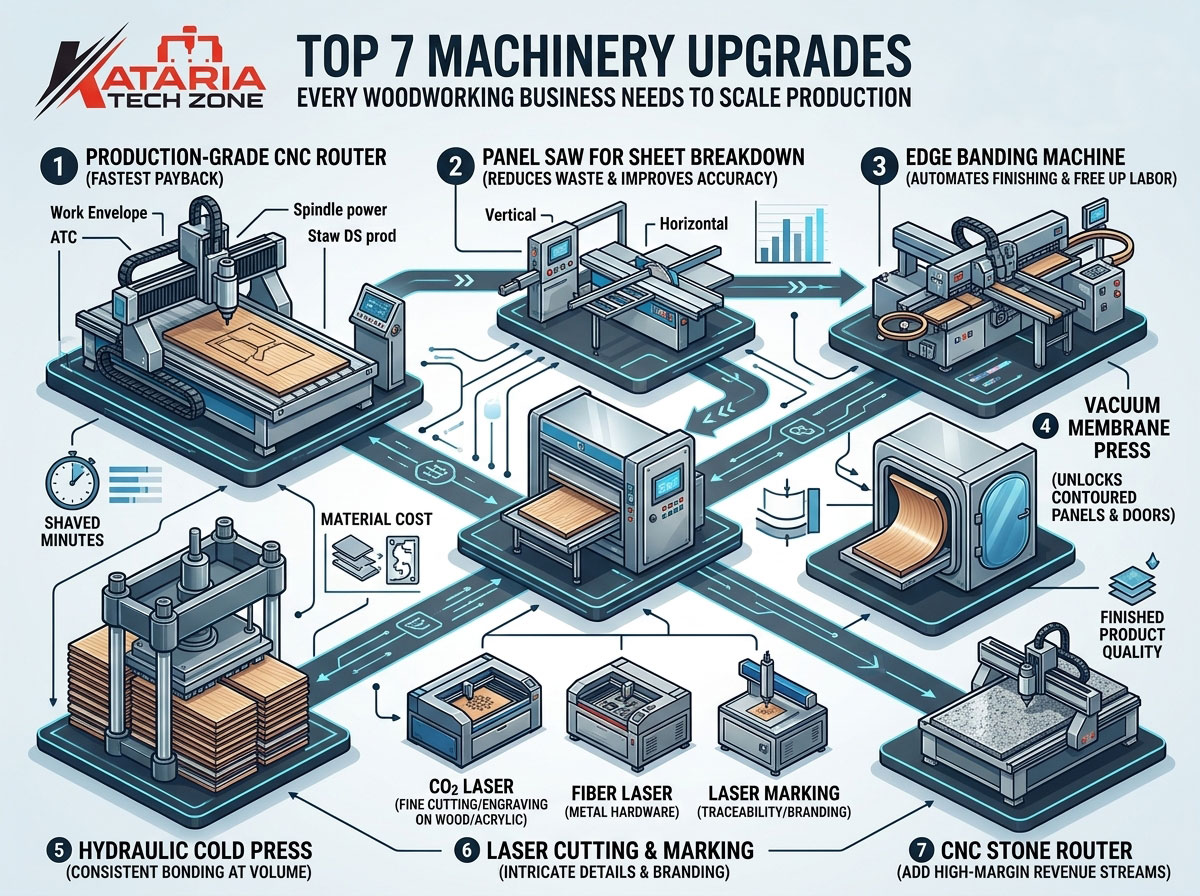
1. A Production-Grade CNC Router
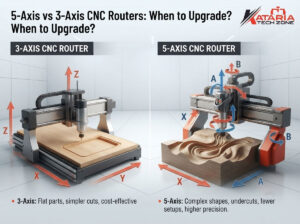
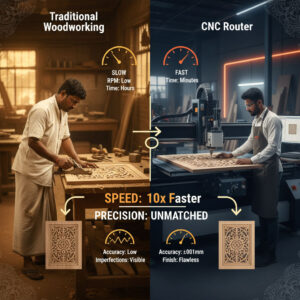
If there’s one upgrade that changes everything, it’s this one. Manual routing and jigsaw-based cutting simply cannot match the speed, repeatability, or precision of a CNC router. Once parts are digitally programmed, a CNC router reproduces them identically at high speed, whether you’re cutting one piece or one thousand.
For scaling shops, the upgrade decision usually comes down to two things: work envelope and automation level. A machine sized for full 4’x8′ sheet goods lets you nest multiple parts per sheet, which directly reduces material waste — often the single biggest hidden cost in a growing shop. Pairing that with an Automatic Tool Changer (ATC) removes one of the most common production bottlenecks: manual bit swaps that stop the machine every time a job needs a different tool.
We covered the full buying framework — work envelope, spindle power, ATC vs. manual, software, and workholding — in our guide on choosing the right CNC router for your woodworking business. If you’re still running manual tools, our post on CNC routers vs. traditional woodworking lays out exactly what changes on the shop floor once you switch.
Bottom line: if you upgrade only one machine this year, this is the one with the fastest, most measurable payback.
2. A Panel Saw for Sheet Breakdown
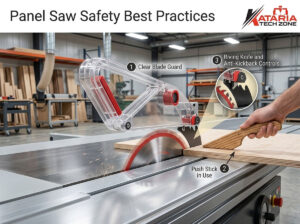
Before any sheet good reaches your CNC router, it usually needs to be broken down into manageable sizes — and doing that with a table saw or circular saw is slow, inconsistent, and a genuine safety risk at scale. A dedicated panel saw solves this bottleneck at the front of your production line.
Panel saws come in two configurations, and the right one depends on your floor space and volume:
- Vertical panel saws stand the sheet upright and move the blade across it — a strong choice for shops with limited floor space, since the machine has a small footprint even though it handles full-size sheets.
- Horizontal panel saws keep the sheet flat and move it through the blade — typically faster for high-volume, repetitive cutting, but they need more floor space to operate.
We break down exactly how these two setups differ in operation and space usage in this comparison of vertical and horizontal panel saws, and the efficiency gains over manual cutting methods in how a panel saw improves efficiency compared to traditional manual cutting.
Why it matters for scaling: a panel saw doesn’t just speed up cutting — it improves the accuracy of every part that goes into your CNC router afterward, reducing rework and material loss downstream.
3. An Edge Banding Machine
Once panels are cut and shaped, raw edges need to be finished — and manual edge taping is one of the slowest, most labor-intensive steps in furniture and cabinet production. An edge banding machine automates this entirely: applying, trimming, and finishing edge banding in a single continuous pass.
For a growing shop, this upgrade matters for two reasons:
- Consistency — machine-applied edge banding is uniform across every panel, which matters enormously for furniture and cabinet clients who notice inconsistent finishing.
- Labor reallocation — edge taping by hand ties up skilled workers on repetitive work. Automating it frees that labor for higher-value tasks like assembly, finishing, or quality control.
If your shop produces cabinets, wardrobes, or laminated furniture at any real volume, an edge banding machine is typically one of the fastest upgrades to justify on labor savings alone.
4. A Vacuum Membrane Press
For shops producing doors, cabinet fronts, or contoured/3D panels, a vacuum membrane press is what makes high-quality laminate or PVC wrapping possible on curved and profiled surfaces — something flat presses simply can’t do.
Vacuum membrane presses use air pressure to pull a heated membrane tightly over a profiled substrate, giving you a seamless, wrinkle-free laminate finish even on routed edges, grooves, and 3D contours. This matters for scaling in a specific way: it opens up an entire product category — profiled doors, decorative panels, contoured furniture fronts — that’s difficult or impossible to finish consistently by hand.
If your product line includes anything beyond flat panels, this is usually the machine that unlocks the next tier of finished-product offerings.
5. A Hydraulic Cold Press
Lamination is one of those processes that looks simple until you’re doing it at volume — and inconsistent pressure or curing time is a common source of delamination and air bubbles, especially as batch sizes grow. A woodworking cold press applies even, controlled hydraulic pressure across full panel sheets, giving you consistent bonding across every board in the batch, not just the ones stacked in the “right” spot under a manual clamp setup.
For scaling shops laminating veneer, decorative sheets, or engineered panels, a hydraulic cold press typically delivers two direct benefits: higher throughput per press cycle (multiple panels pressed simultaneously), and a sharp drop in rework caused by uneven bonding. It’s a less visible upgrade than a CNC router, but for lamination-heavy production lines, it’s often the difference between a bottleneck and a smooth-running batch process.
6. Laser Cutting and Marking Machines
As product lines diversify, many woodworking businesses start layering in laser-based processes — either for intricate cutting work that’s impractical with router bits, or for adding branding, serial numbers, and decorative detailing to finished pieces.
- A laser machine (CO2-based) is well suited to fine detail cutting and engraving on wood, acrylic, and similar materials — ideal for decorative inlays, intricate patterns, and precision engraving that would be slow or difficult on a standard router.
- A fiber laser machine is the go-to choice when metal components enter the picture — hardware, fittings, or metal accents used alongside wood products.
- A laser marking machine is a smaller, more targeted upgrade — permanent branding, batch codes, or serial numbers on finished products, which matters more than it seems once you’re shipping at volume and need traceability or brand consistency across large orders.
None of these typically replace your core cutting equipment — they extend what your shop can offer without adding an entirely new department.
7. A CNC Stone Router (For Businesses Expanding Beyond Wood)
This one won’t apply to every shop, but for woodworking businesses looking to diversify revenue streams, a CNC stone router machine opens the door to marble and granite engraving — countertops, decorative stone panels, and inlay work that commands significantly higher margins than standard woodworking jobs.
Stone routing requires different tooling, coolant systems, and spindle characteristics than wood-focused CNC routers, so it’s a genuinely separate investment rather than a simple accessory. But for shops with the volume and client base to support it, it’s one of the more effective ways to add a high-margin product line without starting a separate business from scratch. We go into the full setup requirements in our ultimate guide to CNC stone routing.
How to Prioritize These Upgrades
With seven possible upgrades and a finite budget, sequencing matters. A practical approach:
- Start where the bottleneck actually is. If sheet breakdown is slowing everything down, a panel saw comes before a second CNC router. If finishing is your rework hotspot, edge banding or lamination equipment comes first.
- Fix the front of the line before the back. Panel saw → CNC router → edge banding → finishing/lamination is the natural production flow. Upgrading a downstream machine while an upstream one is still the bottleneck just moves the queue, it doesn’t remove it.
- Let product mix decide the specialty machines. Laser and stone routing upgrades make sense once your product line already demands them — buying ahead of demand ties up capital that could go toward your core bottleneck.
For a broader look at how modern CNC equipment specifically changes production capability, our post on essential features of modern CNC woodworking machines is a useful next read, and if your growth plan includes decorative panel work, creating MDF wall panels and decorative molding using CNC technology shows how a well-sequenced machinery setup translates into an actual finished product line.
Frequently Asked Questions
What’s the first machinery upgrade a small woodworking shop should make? For most shops, it’s whichever machine is causing the current bottleneck — but if you’re still cutting and shaping entirely by hand, a CNC router almost always delivers the fastest and largest jump in output, since it replaces multiple manual steps at once.
How much floor space do these upgrades typically need? It varies widely by machine and configuration. Vertical panel saws are the most space-efficient way to handle full sheets, while horizontal panel saws, full-size CNC routers, and vacuum membrane presses need more dedicated floor area. It’s worth mapping your shop layout before ordering equipment, since retrofitting space later is far harder than planning for it up front.
Do I need all seven upgrades to scale production? No. Most shops scale successfully with two or three targeted upgrades that address their specific bottleneck — sheet breakdown, cutting, or finishing. The specialty machines (laser systems, stone routers) tend to make sense only once your product mix already demands them.
Is it better to buy one large machine or several smaller ones? It depends on your production flow. A single high-capacity CNC router with ATC can outperform several smaller machines for cutting-heavy shops, but if your bottleneck spans multiple stages (cutting, edge finishing, lamination), spreading investment across dedicated machines for each stage usually improves overall throughput more than concentrating budget in one place.
Scaling With the Right Equipment Partner
Machinery upgrades work best when they’re planned as a system, not bought one impulse purchase at a time. The shops that scale smoothly are the ones that map their production flow first — cutting, shaping, finishing, lamination — and then invest in the specific machine that removes the tightest bottleneck in that flow.
At Kataria Tech Zone, we work with woodworking businesses across India to plan exactly this kind of machinery roadmap — from CNC routers and panel saws to edge banding machines, vacuum membrane presses, hydraulic cold presses, and laser systems. Explore our full product range or read more production insights on the Kataria Tech Zone blog, and get in touch with our team to talk through where your production line needs its next upgrade.