If you’ve spent any time comparing CNC router listings, you’ve probably noticed something confusing: two machines can look almost identical in photos, use the same size work table, and even carry similar price tags — yet one is sold as a “wood and acrylic router” while the other is marketed as capable of cutting brass, aluminum, and other non-ferrous metals. The difference rarely shows up in the spec sheet’s headline numbers. It’s buried in the frame.
Cutting brass and aluminum is a fundamentally different job than routing MDF, plywood, or acrylic. Metal fights back. It pushes against the tool with far more force, generates more heat, and punishes any flex in the machine with chatter, tool wear, and dimensional error. Understanding why a heavy-duty gantry structure handles this and a light frame doesn’t is the single most important thing to get right before you invest in a metal-capable CNC router.
Why Frame Design Matters More Than Motor Power
A lot of first-time buyers assume that cutting metal is mainly about spindle power — get a bigger motor, and you’re set. Power matters, but it’s only useful if the machine can actually hold the tool steady while that power is being applied. This is where frame rigidity takes over as the real deciding factor.
When a router bit engages aluminum or brass, the cutting forces are significantly higher than what the same machine experiences in wood or acrylic. Every one of those forces has to travel somewhere — into the spindle mount, down the gantry, through the linear guides, and into the base frame. If any part of that load path flexes even by a fraction of a millimeter, the result is visible immediately: chatter marks on the cut edge, inconsistent tolerances, premature tool wear, and in worse cases, a snapped end mill or a stalled spindle.
A light-frame router, typically built for wood, foam, and soft plastics, is engineered around a very different force profile. Its structure is optimized for speed and lower mass, not for absorbing repeated metal-cutting shock loads. Ask that same frame to rough out aluminum plate day after day, and the accumulated micro-flex shows up as reduced accuracy and a shorter service life for the entire machine — not just the tooling.
What a Heavy-Duty Gantry Actually Provides
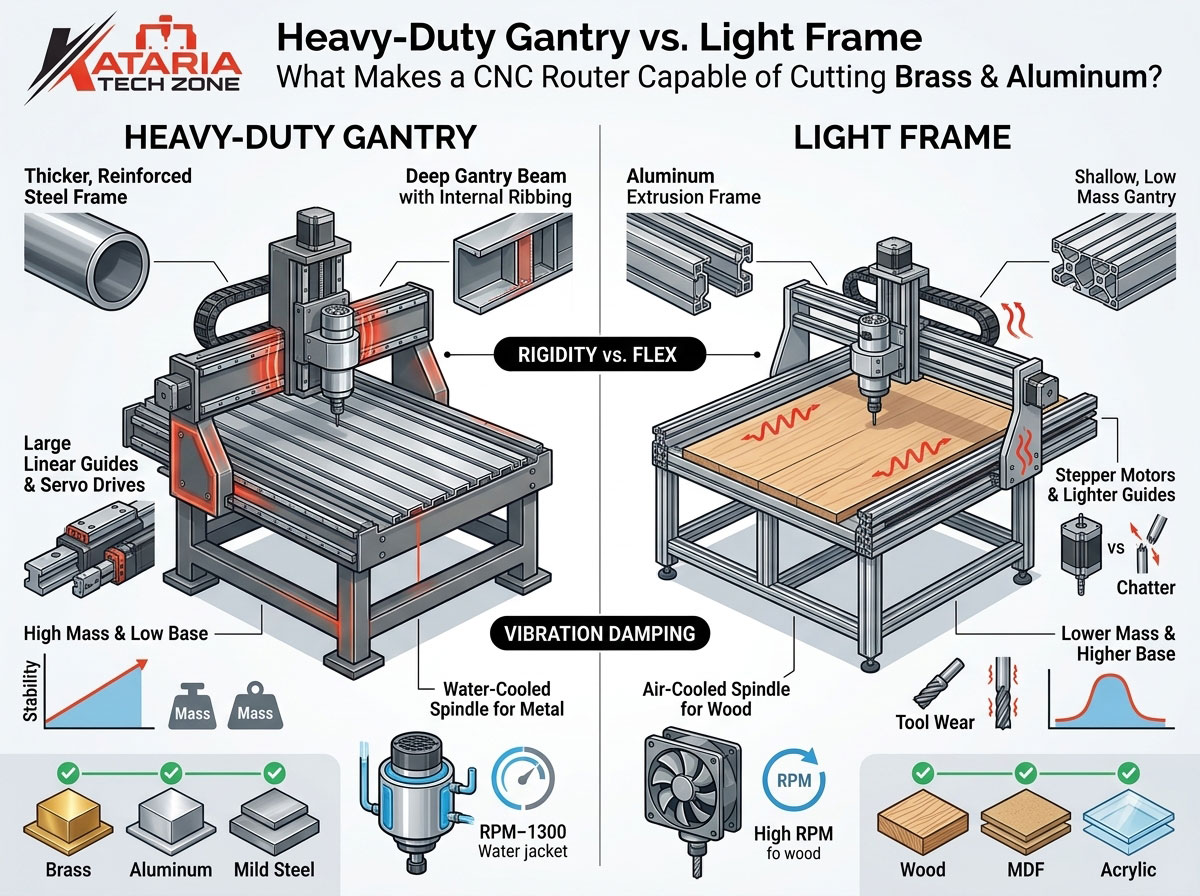
A CNC router built for metal work is not simply a wood router with a stronger spindle bolted on. The engineering starts with the gantry and base structure itself. Here’s what typically separates a metal-capable heavy-duty gantry from a standard light-frame design:
1. Thicker, Reinforced Steel Construction
Heavy-duty gantry routers use thick-wall steel tubing or fully welded steel plate frames, often stress-relieved after welding to prevent warping over time. Some higher-end machines use cast iron gantry components in critical load zones, since cast iron dampens vibration far better than sheet steel. Light-frame machines, by comparison, often rely on thinner aluminum extrusion or lighter steel sections that are perfectly adequate for wood but were never designed to resist metal-cutting reaction forces.
2. Wider, Reinforced Gantry Beam
The gantry beam is the bridge that carries the spindle across the X-axis. On a heavy-duty machine, this beam is deeper and reinforced internally with ribbing to resist twisting (torsional flex) under load. On a light frame, the beam is usually shallower to reduce moving mass and increase rapid-traverse speed — a trade-off that works fine for wood but becomes a liability once you introduce the higher cutting forces of aluminum or brass.
3. Heavier-Duty Linear Guides and Rack-and-Pinion or Ball-Screw Drive
Motion components matter as much as the frame itself. Metal-capable routers typically use larger, higher-load-rated linear guide rails and either precision ball screws or heavy-duty helical rack-and-pinion drives, matched with servo motors that hold position accurately under resistance. Light-frame machines often use lighter guide rails and stepper-driven systems that are cost-effective for wood but can lose steps or introduce backlash when metal-cutting loads spike. If you’re weighing motor and drive options for a metal-capable machine, our comparison of servo and stepper motor CNC routers for high-volume production breaks down which drive system suits which workload.
4. Higher Mass and a Low, Stable Base
Counter-intuitively, more weight is an advantage here. A heavier base absorbs vibration instead of transmitting it, which is why serious metal-cutting CNC routers are noticeably heavier per square foot of table area than their wood-cutting counterparts. Machine mass acts like a shock absorber for every cutting pulse.
5. Water- or Oil-Cooled Spindle Rated for Metal
Cutting brass and aluminum generates heat that wood and acrylic simply don’t produce at the same rate. A spindle built for metal work is usually water-cooled (rather than air-cooled), with a higher torque rating at lower RPM ranges — because metal cutting favors controlled chip load over raw speed. Running a light-duty, air-cooled router spindle on aluminum for extended periods risks overheating and shortened bearing life.
The Role of Clamping and Vibration Damping
Frame rigidity alone doesn’t finish the job — how the workpiece is held matters just as much when you move from wood to metal. Vacuum tables, which work beautifully for flat wood panels, generally aren’t strong enough to resist the lateral cutting forces of metal machining. Metal-capable setups usually rely on T-slot tables, mechanical clamps, or fixture plates that lock the material down rigidly in all directions. We covered this trade-off in detail in our guide to vacuum table versus T-slot clamping for CNC woodworking, and the same clamping logic applies even more strictly once metal enters the picture — a workpiece that shifts even slightly under a metal-cutting load will ruin the part and can damage the tool.
Vibration damping is the other half of the equation. Manufacturers building for metal cutting often add mass-damping elements — filled steel sections, reinforced gussets, or dedicated anti-vibration mounts — specifically to kill resonance before it reaches the cutting edge. A light frame simply doesn’t have this engineering built in, because it was never asked to handle the frequency and force of metal-cutting vibration in the first place.
Signs Your Application Needs a Heavy-Duty Gantry Router
Not everyone cutting the occasional aluminum sheet needs the heaviest machine on the market. Here’s a practical way to think about when the upgrade is worth it:
- You’re cutting aluminum or brass regularly, not occasionally. One-off jobs on thin aluminum sheet can sometimes be handled carefully by a stiffer light-frame machine with the right feeds and speeds. Repeated production work cannot.
- Tolerance matters. If your parts need to hold tight dimensional accuracy across a full production run, frame flex will show up as inconsistency long before the tooling wears out.
- You’re cutting thicker stock. Thin aluminum sheet is far more forgiving than plate stock 10mm and above, where cutting forces climb sharply.
- You need to run unattended or lights-out. A rigid, well-damped frame is far less likely to produce a scrapped batch or a broken tool overnight.
- Surface finish is part of the spec. Chatter from frame flex is one of the most common causes of poor edge finish on metal parts, and no amount of finishing pass will fully fix a structural vibration problem.
If two or more of these apply to your shop, a heavy-duty gantry CNC router isn’t a luxury — it’s the machine that actually does the job you’re asking of it.
Frame Comparison at a Glance
| Feature | Light Frame Router | Heavy-Duty Gantry Router |
|---|---|---|
| Primary material | Aluminum extrusion / thin steel | Thick-wall steel / reinforced steel plate, sometimes cast iron |
| Gantry beam | Shallow, low mass | Deep, internally ribbed for torsional stiffness |
| Drive system | Stepper motors, lighter rails | Servo motors, heavy-duty ball screw or rack-and-pinion |
| Spindle cooling | Typically air-cooled | Typically water-cooled, higher torque rating |
| Best suited for | Wood, MDF, acrylic, foam | Brass, aluminum, mild steel, composite panels |
| Clamping | Vacuum table | T-slot table / mechanical fixturing |
| Machine mass | Lower, favors speed | Higher, favors rigidity and damping |
Common Mistakes Buyers Make When Sizing a Metal-Cutting Router
Even experienced shop owners get caught out by a few recurring mistakes when moving from wood or acrylic into brass and aluminum work:
Judging the machine by table size alone. Two routers with an identical 4×8 ft table can have completely different frame masses and rigidity. Table footprint tells you the working area, not the structural capability underneath it.
Assuming a bigger spindle motor fixes chatter. A more powerful spindle pushed into a flexing gantry just produces the same chatter faster and louder. Torque delivered through an unstable structure doesn’t translate into a clean cut — it translates into vibration.
Ignoring the drive system. Buyers often compare spindle wattage in detail but skip past whether the machine uses stepper or servo motors, or what class of linear guide it runs on. On metal work, the drive system is doing just as much work as the spindle to keep the tool exactly where the program says it should be.
Underestimating dust and chip management differences. Aluminum and brass chips are different from wood dust — they’re sharp, can be pyrophoric in fine-powder form under certain conditions, and need proper chip evacuation and, in many cases, flood or mist coolant rather than dry dust extraction alone. A machine bought purely for wood typically isn’t set up for this from the factory.
Overlooking after-sales support for metal applications. Feeds, speeds, and tooling recommendations for brass and aluminum are different from wood defaults. Buying from a supplier who can support you on metal-specific parameters — not just machine delivery — saves significant trial-and-error time.
Frequently Asked Questions
Can a light-frame CNC router cut aluminum at all? Thin aluminum sheet can sometimes be cut on a stiffer light-frame router with conservative feeds, sharp single-flute tooling, and light depth of cut. It’s workable for occasional, thin-gauge jobs, but it isn’t a reliable setup for regular production or thicker plate.
What frame material is best for cutting brass and aluminum? Thick-wall welded steel and cast-iron gantry components are generally preferred over aluminum-extrusion frames, because steel and cast iron resist flex and dampen vibration far better under metal-cutting loads.
Do I need a water-cooled spindle to cut aluminum? For sustained production work, yes — water cooling manages the heat generated during aluminum and brass cutting far more consistently than air cooling, and it protects spindle bearing life over time.
Is a heavy-duty gantry router slower than a light-frame router? On wood and acrylic, a light-frame router will often out-pace a heavy-duty gantry machine in rapid traverse speed, because it carries less moving mass. On metal, that speed advantage disappears quickly once flex and chatter force you to slow the feed rate down to protect tolerance and tooling.
Choosing the Right Machine for Your Workshop
The honest answer to “gantry or light frame?” comes down to matching the machine’s structural design to what you actually plan to cut, day in and day out. A light-frame router will always be faster and more efficient on wood, foam, and acrylic — that’s exactly what it’s engineered for. But asking it to take on brass or aluminum production work is asking the frame to do a job it wasn’t built for, and the cost shows up later in scrapped parts, worn tooling, and machine downtime rather than upfront.
A heavy-duty gantry CNC router costs more initially because the steel, the drive components, and the spindle cooling system all cost more to engineer and build. But for a shop that’s serious about cutting brass, aluminum, or mixed metal-and-composite work, that upfront investment is what protects your tolerances, your tooling budget, and your production schedule over the life of the machine.
At Kataria Tech Zone, our CNC Router range includes heavy-duty gantry machines engineered with reinforced steel frames, servo-driven axes, and metal-rated spindle options — built specifically for shops that need to move beyond wood and acrylic into brass, aluminum, and mixed-material cutting without sacrificing accuracy or uptime.
Related Reading
- Servo Motor vs. Stepper Motor CNC Routers: Which Is Right for High-Volume Production?
- Vacuum Table vs. T-Slot Clamping for CNC Woodworking: Pros, Cons, & ROI
- Fiber Laser vs. CO2 Laser Cutting: Which Machine Should Metal Fabricators Buy?
Explore Our Machines
Want to see which gantry configuration fits your production volume and material mix? Contact Kataria Tech Zone for a machine recommendation tailored to your workshop.