
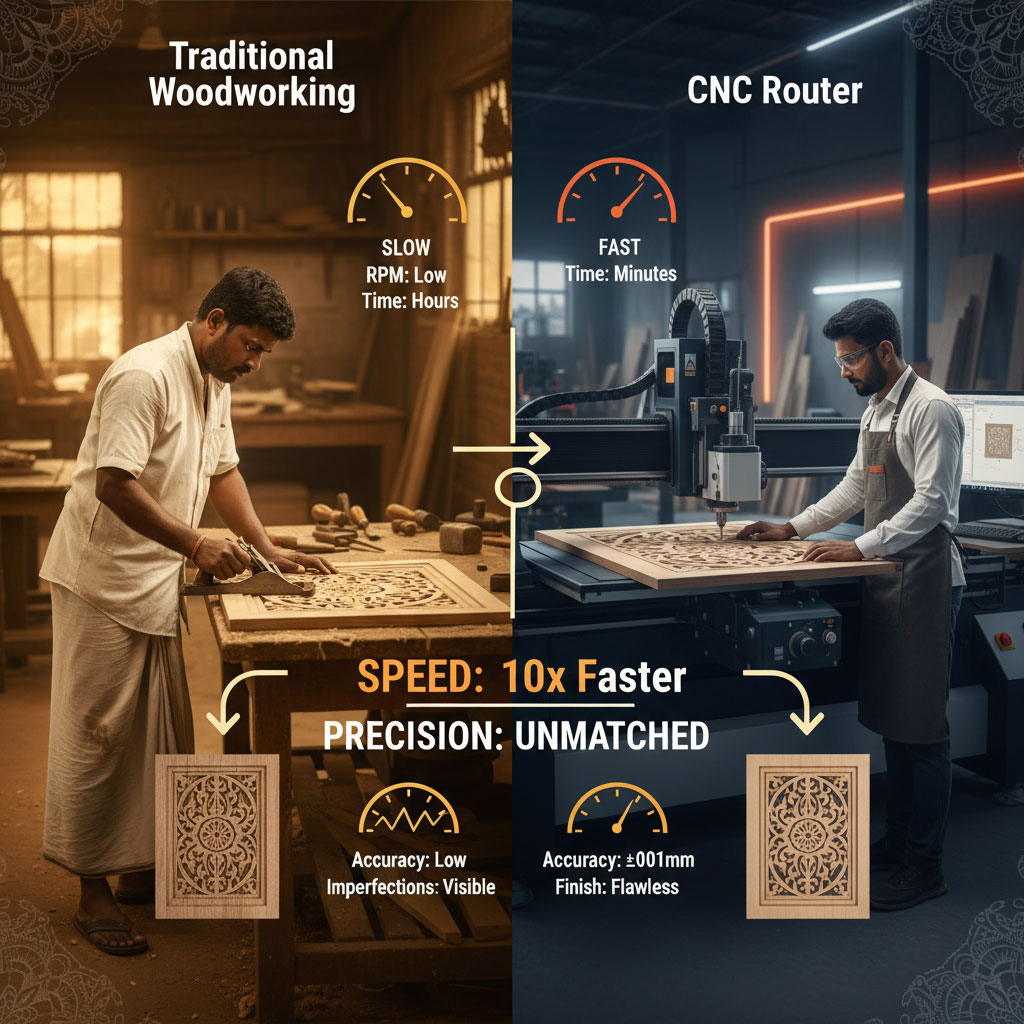
CNC Router vs. Traditional Woodworking Tools: The Ultimate Comparison of Speed, Precision, and Cost
The smell of fresh sawdust and the tactile feel of a hand plane against a slab of oak are the hallmarks of traditional woodworking—a craft that has defined human civilization for millennia. However, as we move further into the digital age, the “thrum” of a servo motor and the high-pitched whine of a 6kW spindle are becoming just as common in modern workshops.
At Kataria Tech Zone, we have seen firsthand how technology is reshaping the industry. The question is no longer just “Can a machine do it better?” but rather “Which tool is right for my business’s growth?” In this guide, we break down the fierce rivalry between the CNC (Computer Numerical Control) router and traditional woodworking tools across three critical pillars: Speed, Precision, and Cost.
1. Defining the Players: CNC vs. Traditional
Before we dive into the data, let’s define what we are comparing.
The Traditional Arsenal
Traditional woodworking relies on “disconnected” power tools and hand tools. This includes:
- Table Saws and Panel Saws: For ripping and cross-cutting.
- Routers (Handheld or Table-mounted): For profiling and joinery.
- Chisels and Hand Planes: For fine detail and fitting.
- Drill Presses: For vertical boring.
The CNC Powerhouse
A CNC router, like the high-precision models manufactured at Kataria Tech Zone, integrates all these functions into a single, automated platform. Using G-code (the language of the machine), a CNC can cut, drill, carve, and engrave with a single setup.
2. The Speed Factor: Throughput vs. Artistry
In business, time is the only resource you can’t buy back. When comparing speed, we must look at both Cycle Time (how fast a part is made) and Lead Time (how fast a project is finished).
CNC: The “Employee That Never Sleeps”
A CNC router excels in high-speed, repetitive tasks.
- Continuous Operation: Unlike a human operator who needs breaks, a CNC can run 24/7.
- Nesting Efficiency: Advanced software “nests” dozens of parts onto a single sheet of plywood, cutting them all in one go. What would take a craftsman 4 hours of measuring, marking, and individual cutting on a table saw takes a CNC roughly 15 to 20 minutes.
- Multi-Tasking: A CNC can perform drilling, pocketing, and contouring without the piece ever leaving the vacuum bed.
Traditional: The Speed of Skill
Traditional tools are faster only in one scenario: The “One-Off” simple cut. If you need to rip a single board to width, it’s faster to walk to a table saw than to draw a file in CAD, generate toolpaths, and set up the CNC. However, as soon as the project involves more than three parts or a complex shape, the traditional method falls behind.
| Task | Traditional Tools | CNC Router |
| Cutting 50 Cabinet Doors | 12–16 Hours | 2–3 Hours |
| Intricate 3D Carving | Days (by hand) | 1–2 Hours |
| Drill 100 Shelf Pin Holes | 45 Minutes (with jig) | 4 Minutes |
3. Precision: The Science of “Perfect”
Precision in woodworking is often measured in “thousands of an inch.”
The Human Margin of Error
Traditional tools are only as precise as the person holding them. Even the most skilled artisan deals with:
- Parallax Error: Slight misalignments when reading a tape measure.
- Fatigue: The 50th cut is rarely as accurate as the 1st.
- Cumulative Error: A 1mm mistake in the first cut can lead to a 5mm gap by the final assembly.
The CNC’s Mathematical Certainty
Kataria Tech Zone machines utilize servo motors and high-grade lead screws to achieve tolerances that are physically impossible for humans to maintain.
- Repeatability: If you need 1,000 identical chair legs, the 1st and the 1,000th will be identical down to $0.01mm$.
- Complex Joinery: CNCs can cut perfect dovetails, mortise-and-tenon joints, and “RTA” (Ready-To-Assemble) fittings that snap together like LEGO bricks.
4. Cost Analysis: Short-Term Pain vs. Long-Term Gain
For many business owners in India, the decision often comes down to the initial “check” they have to write. However, a smart investor looks at the Total Cost of Ownership (TCO) and the Return on Investment (ROI).
Initial Investment
The entry cost for a traditional workshop is lower, but it scales linearly with your production needs.
- Traditional Workshop: To set up a professional-grade manual shop in India today, including a heavy-duty table saw, surface planer (randa), thickness planer, and drill press, you can expect to invest between ₹3,50,000 and ₹7,00,000. While you can start cheaper with hobbyist tools, industrial-grade manual machines required for a business come with a higher price tag.
- CNC Powerhouse: A professional-grade Kataria Tech Zone CNC Router—equipped with high-torque servo motors, a vacuum bed for workpiece holding, and a high-speed spindle—typically starts around ₹6,50,000. While the upfront cost is higher than a single manual tool, this one machine replaces the functions of several manual ones.
The “Hidden” Costs of Traditional Woodworking
While traditional tools are cheaper to buy, they are more expensive to run in a business environment:
- Labor Costs: To match the output of a single Kataria CNC, you would need 3 to 4 highly skilled carpenters. In 2025, skilled labor is not only expensive but increasingly hard to find and retain.
- Material Wastage: Manual errors often lead to “re-dos.” With high-quality plywood and hardwood prices rising, even a 5% waste reduction through CNC nesting can save your business ₹15,000 to ₹25,000 per month.
- Electricity & Floor Space: A single CNC takes up less floor space than five separate manual machines and often consumes less power than running multiple machines simultaneously.
The Verdict on ROI
For a small artisan shop making 1-2 custom pieces a month, traditional tools make sense. But for any workshop aiming for ₹10 Lakh+ monthly turnover, the Kataria Tech Zone CNC Router typically pays for itself through labor and material savings in just 12 to 14 months.
5. Why Choose Kataria Tech Zone?
We don’t just sell machines; we provide the backbone for your workshop’s evolution. Our CNC routers are engineered with:
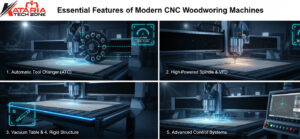
- Servo Motor Technology: For smoother, faster, and more reliable movement than standard steppers.
- Robust Build Quality: Designed to handle the rigors of Indian industrial environments.
- Local Support: Based in Amritsar, we provide the after-sales service that international brands often struggle to match.
6. Conclusion: Which is Right for You?
The “CNC vs. Traditional” debate isn’t about one replacing the other; it’s about integration. * Choose Traditional if you value the meditative process of hand-crafting, focus on one-of-a-kind art pieces, or have a very limited startup budget.
- Choose a CNC Router if you want to grow your business, require flawless consistency, want to offer complex 3D designs, or need to reduce your dependency on hard-to-find skilled labor.
At Kataria Tech Zone, we believe in empowering craftsmen with the best of both worlds. Our machines take care of the “heavy lifting” and “repetitive math,” leaving you free to focus on the creative finishing touches that make your work unique.



One thought on “CNC Router vs Traditional Woodworking Tools: Speed, Precision, and Cost Comparison”