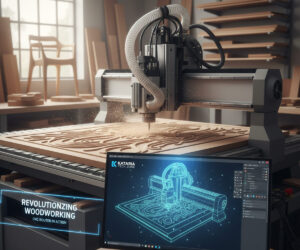
A CNC router for woodworking is a computer-controlled cutting machine that uses a rotating router bit to cut, carve, mill, drill, and shape wood and other materials with high precision. It operates by following programmed instructions from CAD/CAM software, which directs the machine’s tool movement along the X, Y, and Z axes to create detailed designs, intricate patterns, and complex shapes automatically.
Key features of CNC routers for woodworking include:
- Computer Numerical Control (CNC): The machine follows digital instructions (G-code) generated from designs, allowing automated and highly accurate cuts that minimize human error.
- Multi-axis Movement: Typically moves the cutting tool in three directions—front/back (X-axis), left/right (Y-axis), and up/down (Z-axis)—to produce 2D, 2.5D, or 3D shapes.
- Versatility in Operations: Capable of performing various operations such as cutting, engraving, drilling, grooving, and 3D carving.
- High-Speed Spindle: The router bit spins at high revolutions per minute (RPM), enabling fast cutting through wood and related materials.
- Material Compatibility: Efficient at working with wood, plastics, foam, composites, and some non-ferrous metals like aluminum.
- Automation and Repeatability: Can produce consistent, identical parts in volume, beneficial for furniture making, cabinetry, signage, and decorative wood arts.
- Advanced Features: Some CNC routers include automatic tool changers, digital controllers, vacuum material hold-downs, and dust collection systems to enhance precision, ease of use, and safety.
In summary, a CNC woodworking router is a precision tool that automates woodworking processes to produce high-quality, intricate designs with speed and accuracy beyond manual methods.